
This guide breaks down the best note taking method for biology in college: a simple system for lectures, labs, and exam review.
Biology can feel like a nonstop sprint: fast lectures, dense vocabulary, and labs where one missing detail can ruin your results. If you’ve ever reread your notebook and thought, “I still don’t get it,” you’re not alone. This guide shows how to take notes for biology in college using a simple, repeatable system that works for lectures and labs—especially if you’re juggling commuting, a part-time job, or midterm prep.
Snippet-ready definition: Biology note-taking is turning lectures, readings, and lab work into organized, test-ready explanations you can recall and apply on exams.
Quick Start box: “If you only have 10 minutes, do this…”
- Write today’s topic as a question (ex, “How does DNA replication stay accurate?”).
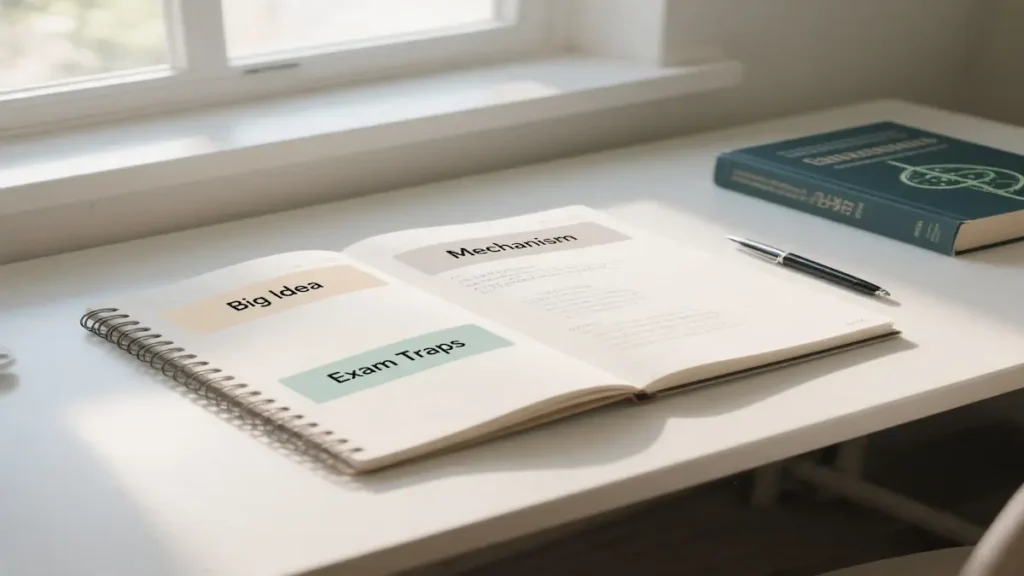
- Split your page into three zones: Big Idea, Mechanism, Exam Traps.
- Capture only: definitions, cause-and-effect links, and steps with the “why.”
- Do a 2-minute active recall brain dump after class (no notes).
- Add three practice questions at the bottom for review.
Why Do Biology Notes Fail?
Most biology lecture notes fail for one reason: they’re built for recording, not retrieval.
College biology tests rarely reward copying slides. They reward your ability to:
- explain processes (pathways and cycles),
- connect cause and effect,
- interpret diagrams and data,
- predict outcomes when variables change.
So your notes shouldn’t look like a transcript. They should look like a study tool you can use for exam review, spaced repetition, and quick midterm prep.
Best Note Taking Method for Biology (The L.A.B.-Ready System)
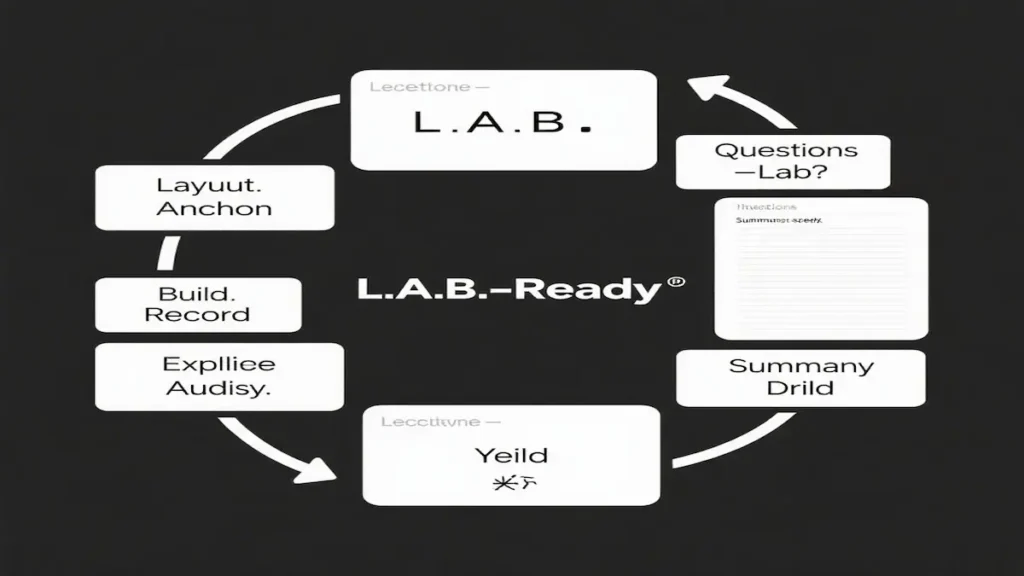
Use one consistent “note-taking system” so every lecture and lab feeds your studying.
“If you want the big-picture framework first (a simple note-taking system that works for any major), start here: [the simple note-taking system that works for any major]. Then use this biology guide as your subject-specific version for lectures + labs.”
The L.A.B.-Ready System (repeatable weekly)
- L — Layout notes for quick scanning and self-testing
- A — Anchor to what exams ask (explain, compare, predict)
- B — Build the mechanism (steps + why it works)
- R — Record lab work (conditions, decisions, data)
- E — Explain with a short rewrite in your own words
- A — Audit gaps using a checklist
- D — Drill with questions made from your notes
- Y — Yield a one-page summary sheet per unit
This is the difference between “I have notes” and “I can score.”
How to Take Notes for Biology in Lectures?
Your goal in lecture is to capture structure: definitions, relationships, and the logic behind processes. That’s the best way to take biology notes without drowning in details.
What Should You Write Down?
Write what helps you recreate understanding later:
- key terms + definitions (in plain English),
- inputs/outputs (what goes in, what comes out),
- where it happens (cell part, organ, tissue),
- cause → effect arrows (“if X increases, Y decreases”),
- professor’s emphasis (examples they repeat, “this will be on the exam”).
If you’re typing, keep it clean and scannable. If you’re handwriting, keep it brief and leave space for clarifying notes after class.
What Should You Skip in Class?
Skip what you can re-find later:
- full sentences from slides,
- The textbook explains the extra detail better.
- long stories/examples—capture the pattern, not the script.
A good rule: if it doesn’t help you answer a question, it doesn’t belong in your main notes.
How Do You Capture Processes Fast?
Biology is loaded with mechanisms—cell signaling, respiration, transcription/translation, and immune responses. Use a “process strip” format that works every time:
Process Strip Template
- Trigger: what starts it
- Steps: 3–7 major steps (not 25 micro-steps)
- Output: what it produces
- Why it matters: the point of the process
- Break point: what happens if a key step fails (mutation, inhibitor, missing enzyme)
Snippet-friendly numbered list (lecture capture rules):
- Write the why behind each step.
- Note inputs/outputs + location.
- Add one break point prediction.
- Turn it into a self-test question.
How Do You Upgrade Slide Notes?
Slides are often “presentation-ready,” not “exam-ready.” Upgrade them using:
D.E.E.P. Slide Upgrade
- Define: say it in your own words
- Explain: write the mechanism or reasoning
- Example: one realistic scenario (drug, mutation, environment)
- Predict: change one variable and predict the outcome
This turns copied content into actual learning—fast.
How Do You Simplify Diagrams?
Diagrams are high-yield in biology (anatomy labeling, cell structures, pathways, phylogenies). Don’t aim for perfect art. Aim for memory.
Snippet-friendly bulleted list (diagram essentials):
- Title (what it represents)
- Direction arrows (flow of information/energy)
- Key labels (only test-relevant)
- One break point (what fails if disrupted)
If you can redraw a simplified diagram from memory in 60 seconds, you’re studying effectively.
How Should You Take Lab Notes?
Biology lab notes should support three things: lab performance, lab reports, and practical exams. That means your lab notebook format must capture decisions and data—not just steps.
What Must You Record in the Lab?
Write what you can’t reconstruct later:
- conditions (time, temperature, concentrations, controls),
- deviations (anything you did differently),
- observations (color change, cloudiness, gel band pattern),
- quick interpretation (what you think it means and why).
Lab is where “small details” count most, especially on write-ups.
How Do You Write P.E.E.R. Notes?
Use this in every lab. It’s clean, fast, and lab-report-friendly.
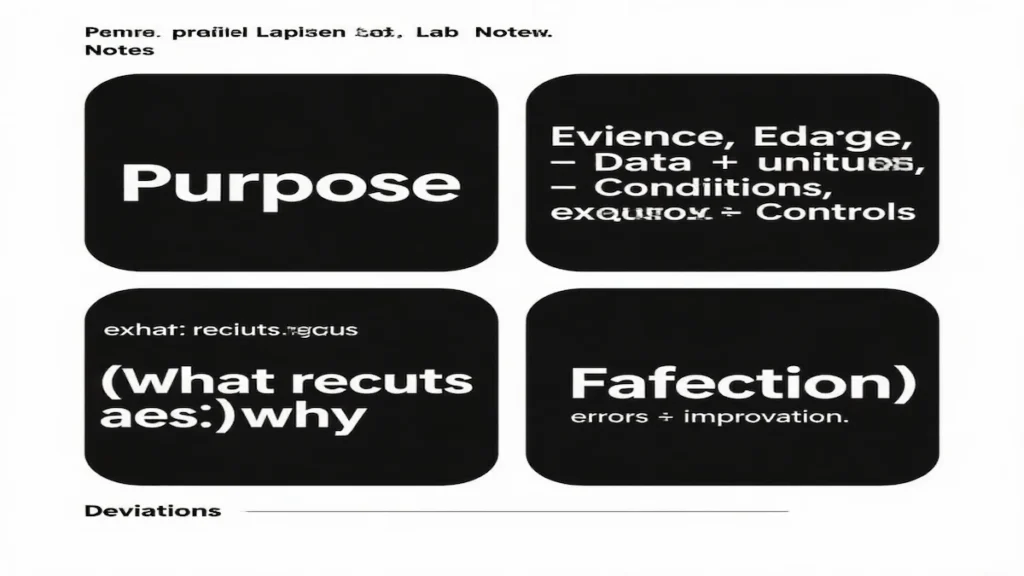
P.E.E.R. Lab Notes
- Purpose: What question are we answering?
- Evidence: data + units + conditions (include controls)
- Explanation: what the results suggest, and why
- Reflection: likely errors + what you’d change next time
Even if your results are “bad,” strong documentation + interpretation can still earn points.
What Should You Do After Class?
This is where learning sticks. You don’t need hours—just consistency.
What’s the 5 5–2 Routine?
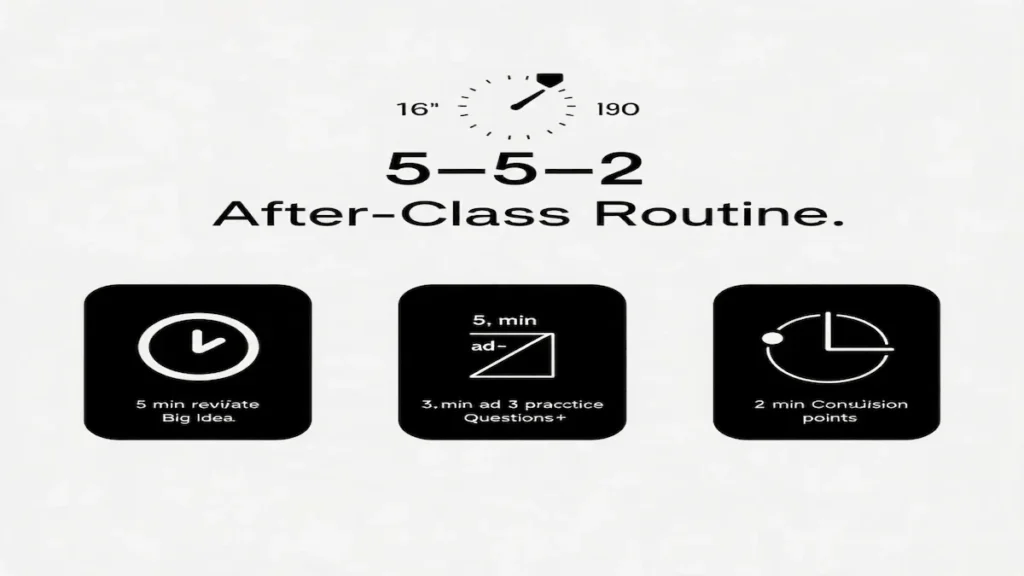
- 5 minutes: rewrite the Big Idea as a short explanation
- 5 minutes: add three practice questions + one memory diagram
- 2 minutes: circle confusion points for office hours/TA
This naturally supports spaced repetition because you’re building review prompts as you go.
What Does This Look Like Realistically?
Example 1: Fast lecture before midterms
You’re in a packed lecture on gene regulation, and the professor moves faster than the slides.
You use the process strip:
- Trigger + key steps + output
- Add a break point prediction: “What happens if this repressor can’t bind?”
- Add an exam trap note: similar terms that get confused
Now your biology note-taking isn’t just “facts”—it’s test-ready logic.
Example 2: Lab day with messy results
Your enzyme activity lab gives weird results.
Your biology lab notes record:
- exact temperatures and timing,
- the control setup,
- the unexpected observation,
- Your explanation (possible enzyme denaturation, pH drift, measurement error)
Later, your lab report is easier because your evidence is already organized.
Example 3: Commuting + part-time job
You have 20 minutes between commuting and a shift.
You do a micro-review loop:
- 2-minute brain dump (active recall)
- Answer 2 questions from yesterday’s notes
- Redraw 1 diagram from memory
That’s how you stay afloat without long study blocks.
What If You’re Behind or Cramming?
If you’re overwhelmed, your goal is not perfect notes. Your goal is minimum viable mastery.
What’s the 72-Hour Rescue Plan?
Day 1: Triage
- List topics for the unit
- Star what your professor emphasized
- Pick the top 3–5 high-yield concepts first
Day 2: Build “Minimum Viable Notes”
For each topic, create one page:
- definition in your own words
- process strip (if applicable)
- One diagram from memory
- 5 practice questions (explain/predict)
Day 3: Drill + Patch
- Do questions first, then patch your notes
- Bring 2–3 “why” questions to office hours
- Make a one-page summary sheet for the unit
This beats rereading for hours because it forces retrieval and application.
Are Your Notes Actually Working?
Quick diagnostic checklist (yes/no):
- Can you explain the concept without looking?
- Do you have at least three practice questions per lecture?
- Did you capture inputs/outputs + location for key processes?
- Can you predict outcomes if a step is inhibited/mutated?
- Do your lab notes clearly include conditions and deviations?
- Can you review the unit from a summary sheet?
Score it
- 0–2 yes: your notes are mostly transcripts—switch to the system now
- 3–4 yes: you’re close—add more self-testing + memory diagrams
- 5–6 yes: your notes are exam-ready
Common Student Mistakes (3–6 + fixes)
- Copying slides word-for-word
- Fix: Use D.E.E.P. on key slides only.
- Writing definitions you can’t explain
- Fix: Rewrite each key term in plain English + add one example.
- No questions in your notes
- Fix: Add three practice questions per lecture (explain + predict).
- Pretty notes, weak recall
- Fix: Prioritize memory diagrams and brain dumps over aesthetics.
- Lab notes missing conditions
- Fix: Record time/temperature/concentration/controls every time.
Templates/Examples (checklist/study plan/scripts/rubric)
Biology Lecture Notes Template (copy/paste)
Topic question:
Big Idea (1 sentence):
Key terms (plain English):
Cause → effect links:
Process strip (trigger → steps → output → why):
Break point prediction:
Exam traps (common confusions):
Practice questions (3):
1.
2.
3.
Memory diagram (from memory):
Biology Lab Notes Template (P.E.E.R.)
Purpose:
Evidence: (data + units + conditions + controls)
Explanation: (what it suggests + why)
Reflection: (errors + improvements + next step)
Office Hours Script (fast + confident)
“Hi Professor/TA, I’m reviewing [topic]. I can explain [what I understand], but I’m stuck on [specific why].
If [variable changes], I predict [outcome]—is my reasoning correct?”
Weekly Study Plan (built for real schedules)
- After each lecture: 5–5–2 routine
- Twice per week (20–30 min): review questions + redraw one diagram
- Weekend (60–90 min): one-page summary sheet + mixed practice questions
Brief comparison table (if relevant)
| Method | Works for Biology? | Best use | Watch out for |
|---|---|---|---|
| Copying slides | ❌ | Quick reference | Low retention, weak exam performance |
| Cornell notes | ✅ | Organized review cues | Needs bio-specific processes/diagrams |
| L.A.B.-Ready system | ✅✅ | Lectures + labs + exams | Requires consistency |
| Mind mapping | ⚠️ | Big-picture connections | Can miss step-by-step mechanisms |
| Concept mapping | ✅ | Cause-and-effect relationships | Can become time-consuming |
Key Takeaways
- The best biology notes are built for retrieval, not transcription.
- Use a repeatable note-taking system for lectures and labs.
- Capture processes with a trigger → steps → output → why format.
- Turn slides into learning using D.E.E.P. (define, explain, example, predict).
- Keep lab notes evidence-focused with P.E.E.R. (purpose, evidence, explanation, reflection).
- Use active recall and spaced repetition by adding questions immediately.
- When behind, use the 72-hour rescue plan and focus on high-yield topics.
FAQ
What’s the best way to take biology notes?
Use a structured format that captures mechanisms, cause-and-effect, and self-test questions. Notes that generate practice questions are more useful than notes that record content.
Should I type or handwrite biology notes?
Either works if you summarize and self-test. Typing helps organize diagrams and templates; handwriting can slow you down in a good way and reduce copying.
How do I take notes in biology labs?
Use a lab notebook format that records conditions, controls, deviations, and interpretations. P.E.E.R. notes make lab reports and practical exams much easier.
How many practice questions should I make per lecture?
Aim for a minimum of three. Include at least one “predict the outcome” question because biology exams often test application, not memorization.
How do I catch up before a biology midterm?
Triage high-yield topics, build minimum viable notes (definition, process strip, diagram, questions), then drill with active recall. Patch gaps using office hours.
What is the best note taking method for biology?
The best note taking method for biology is a structured system that captures mechanisms (steps + why), cause-and-effect, and diagrams, then turns your notes into practice questions for active recall. A reliable option is the L.A.B.-Ready method, which organizes each lesson into a Big Idea, the mechanism, common exam traps, and self-test questions—so your notes are exam-ready and easy to review.
Conclusion
Biology becomes much less stressful when your notes stop being a transcript and start being a system you can study from. Use the lecture structure, the lab P.E.E.R. format, and short daily review loops to stay consistent—even with commuting or a part-time job. Once you master taking notes in biology, studying becomes faster, clearer, and far more effective.
Related Posts:
- Best Note Taking Apps for Students on Mac (Study…

- Best Method to Take Notes: Question-Led Notes for…

- Best Products for Students: 25 Useful Essentials…

- Best Budget Headphones for Students Worth Buying

- Best Microphone for Students: 7 Top Picks for 2026
- Best School Supplies for Students: 15 Useful Picks for 2026