
If you missed half a lecture because the bus ran late, your work shift ran over, or you zoned out during a rough week, you’re not doomed. How to catch up on missed lectures is less about “redoing everything” and more about rebuilding the right notes so you can follow the next class without panic. If you’ve been searching for what to do if you miss a lecture, this recovery method is your answer.
Definition (snippet-ready): A missed-lecture recovery method is a repeatable process that reconstructs the key ideas, examples, and assignments from a lecture using official materials, quick peer input, and targeted self-testing—so you can participate and perform on assessments.
This guide is for college students who need a realistic fix that works during midterms, labs, and packed schedules.
Quick Start: “If you only have 10 minutes, do this…”
Open your course site and pull up today’s lecture slides (and any posted outline). Skim for headings and learning objectives, then write a one-paragraph lecture recap: “what this lecture was trying to teach” in your own words. Finally, create three “If I had to explain this to a friend…” questions you’ll answer later using retrieval practice to fill gaps in your notes.
How to catch up on missed lectures (Recovery Method)
“Caught up” doesn’t mean perfect notes. It means you can walk into the next class and:
- understand what the instructor is referencing,
- complete the next homework without guessing,
- and recognize what you still don’t know (so you can fix it fast).
Your target is a usable set of missed lecture notes: concepts + worked examples + any instructions that affect grades (quiz rules, problem set details, lab steps).
Next step: Put a calendar hold for one focused block (even 30–45 minutes) before your next class meeting. Recovery works best when you do it once, then reinforce with spaced repetition.
The 4R Recovery Notes System
This is the system you’ll repeat anytime you miss a chunk: 4R = Retrieve, Rebuild, Reduce, Reinforce. Use it whether you have a lecture recording (or class recording) or only the slides.
Step-by-step workflow
1) Retrieve the official skeleton (5 minutes).
Pull the syllabus, lecture slides, assigned reading sections, and any posted worksheet. Your job is to capture the lecture’s “spine” (topics in order), not details yet. This is the fastest way to catch up on lecture notes without drowning.
2) Rebuild a “good-enough” timeline (15–25 minutes).
On a single page, reconstruct notes in the same flow the instructor used: main concept → why it matters → instructor example → typical mistake.
If there’s a class recording, watch at 1.25–1.5x and pause only to capture definitions and steps. If there isn’t, use the slides + text to rebuild the sequence.
3) Reduce into exam-ready cues (10 minutes).
Turn messy paragraphs into short prompts you can test yourself on later. Aim for cues like “Explain X in 2 sentences” or “Solve Y type problem without looking.” These cues are what make your missed class notes actually usable.
4) Reinforce with active recall (10 minutes).
Close everything. Answer your prompts from memory (active recall). This is where learning locks in. If you blank, reopen materials only to patch the exact gap—don’t reread the whole lecture.
5) Repair with one human touchpoint (5 minutes).
Send a quick message to a classmate, or bring one targeted question to office hours. If needed, email your professor/TA with one specific question. One clean clarification can save an hour of confusion.
Next step: Create a dedicated “Recovery Notes” section in your notebook (or a separate doc) so these pages don’t get lost among regular notes.
What if there’s no recording?
Use the slides + textbook + one peer’s notes to rebuild the sequence. If the class relies on the instructor’s spoken steps (common in math, chemistry, coding), borrow notes from classmates for the missing example or procedure—then bring one “here’s what I reconstructed—what did I miss?” question to office hours. The goal is confirmation, not a full re-lecture.
Real-life examples (lecture + lab + busy week)
Example Box: The Recovery Method in three real situations
1) Lecture hall (Psych 101): You arrived 25 minutes late and missed the explanation of classical vs. operant conditioning.
You review lecture slides, rebuild the difference using the textbook section, reduce it to two prompts (“define each,” “give a campus example”), then do a quick recall check before discussion.
2) Lab (General Chemistry): You missed the first half where the TA showed how to set up the titration and record the lab notebook table.
You rebuild the procedure from the lab handout, then ask a lab partner for one photo of the data table format (not their data). You finish by writing a clean “steps + safety + common errors” block to avoid messing up the next session.
3) Midterms + part-time job week: You missed a statistics lecture after a closing shift, and you’re exhausted.
You do a 35-minute rebuild focused only on the problem type that shows up on the practice exam, then reinforce with two timed practice questions. You’re not perfect—but you’re functional for the next class and ready for exam revision.
Next step: Pick one upcoming assessment (quiz, lab report, problem set). Let that decide what “enough notes” means right now.
If you’re behind: Today + next 48 hours plan
When you’re overwhelmed, your brain tries to “collect everything.” Recovery works when you prioritize what moves grades.
Today (30–60 minutes)
- Rebuild the lecture spine and a single-page summary.
- Identify the top 3 confusion points.
- Do one short recall session (closed notes) and mark what breaks.
Next 48 hours (two short blocks)
- Block 1: Do targeted practice (one problem set section or a few practice questions).
- Block 2: Attend office hours or ask a study group buddy your top question, then update your notes immediately while it’s fresh.
Next step: If you missed more than one lecture, recover the most recent first. It usually unlocks the earlier one.
Mini-quiz: Are you actually caught up?
Score yourself 0–2 on each item (0 = no, 1 = kind of, 2 = yes). Total out of 10.
- Can I explain the main idea in two sentences without looking?
- Do I have at least one worked example (or step-by-step process) written clearly?
- Can I do a short practice question and check my work?
- Do my notes include any instructions that affect grades (due dates, rubric notes, required format)?
- If the professor references this lecture next class, will I recognize what they mean?
Scoring
- 0–4: You’re not caught up yet—do another 30-minute 4R pass.
- 5–7: You’re functional—reinforce with one more recall + practice block.
- 8–10: You’re back—switch to spaced repetition to keep it.
Common Student Mistakes (3–6 + fixes)
Mistake 1: Rewatching the whole recording like a movie.
Fix: Watch only to capture definitions, steps, and instructor examples—then test yourself immediately.
Mistake 2: Copying slides word-for-word.
Fix: Slides are prompts, not notes. Add your own “why,” a sample problem, and a typical error.
Mistake 3: Asking friends for “everything you wrote.”
Fix: Ask for one specific missing piece (the example problem, the diagram labels, the instruction you missed).
Mistake 4: Trying to recover three lectures in one night.
Fix: Recover the most recent lecture first, then backfill in short blocks across the week.
Mistake 5: Skipping the human touchpoint.
Fix: Use office hours once with one prepared question. It’s faster than guessing for days.
Templates/Examples (checklist/study plan/scripts/rubric)
Recovery Notes Page Template (copy/paste)
Course + date missed:
Lecture title/topic:
Goal (what this lecture should let me do):
Key terms (plain-English meaning):
Process/steps (if applicable):
Instructor example (my version):
One practice prompt (closed notes):
My top question for office hours:
10-Minute Office Hours Script
“Hi Professor/TA— I missed the first part of class and rebuilt the notes from slides and the text. I’m stuck on [one specific concept]. Can you confirm if my understanding is right, and what I should practice?”
Two-Block Catch-Up Study Plan (fits a commute/work schedule)
Block A (35 minutes): rebuild + reduce + 5-minute recall
Block B (25 minutes): practice + quick corrections + rewrite one confusing section cleanly
Quick Self-Grading Rubric for Your Rebuilt Notes (0–2 each)
Clarity (I can read it tomorrow)
Completeness (definitions + example + instructions)
Testability (prompts I can answer)
Accuracy (confirmed by practice/peer/office hours)
Key Takeaways (5–7 bullets)
- Missing part of class is recoverable if you rebuild usable notes instead of “perfect” notes.
- Use the 4R system: Retrieve → Rebuild → Reduce → Reinforce, then confirm one point with a human.
- Active recall beats rereading when time is tight.
- Recover the most recent lecture first to avoid stacking confusion.
- Make your notes testable with short prompts and one worked example.
- A today + 48-hour plan prevents backlog from turning into panic.
FAQ
Should I ask the professor for notes if I missed class?
Usually, ask for clarification—not full notes. Bring what you rebuilt and ask one precise question.
Is it better to type or handwrite recovery notes?
Either works if you reduce into prompts and do recall. If typing makes you copy-paste, switch to handwriting (or type, then summarize by hand).
What if my classmate’s notes don’t match the slides?
Trust official materials first. Use peers to fill gaps in examples or spoken explanations, then verify during office hours if it affects grades.
How do I catch up if I missed a lab demonstration?
Start with the lab handout and required data tables, then confirm setup steps with a partner or TA before you touch equipment.
How long should catch-up take for a half-missed lecture?
Often 45–90 minutes split into two blocks: rebuild + reduce first, then practice + recall later. If it’s taking longer, you’re probably rereading instead of testing.
Conclusion
You don’t need a marathon study session to recover—you need a repeatable process that turns official materials into testable notes, plus one quick clarification to close the loop. If you use this method consistently, how to catch up on missed lectures becomes a routine
Related Posts:
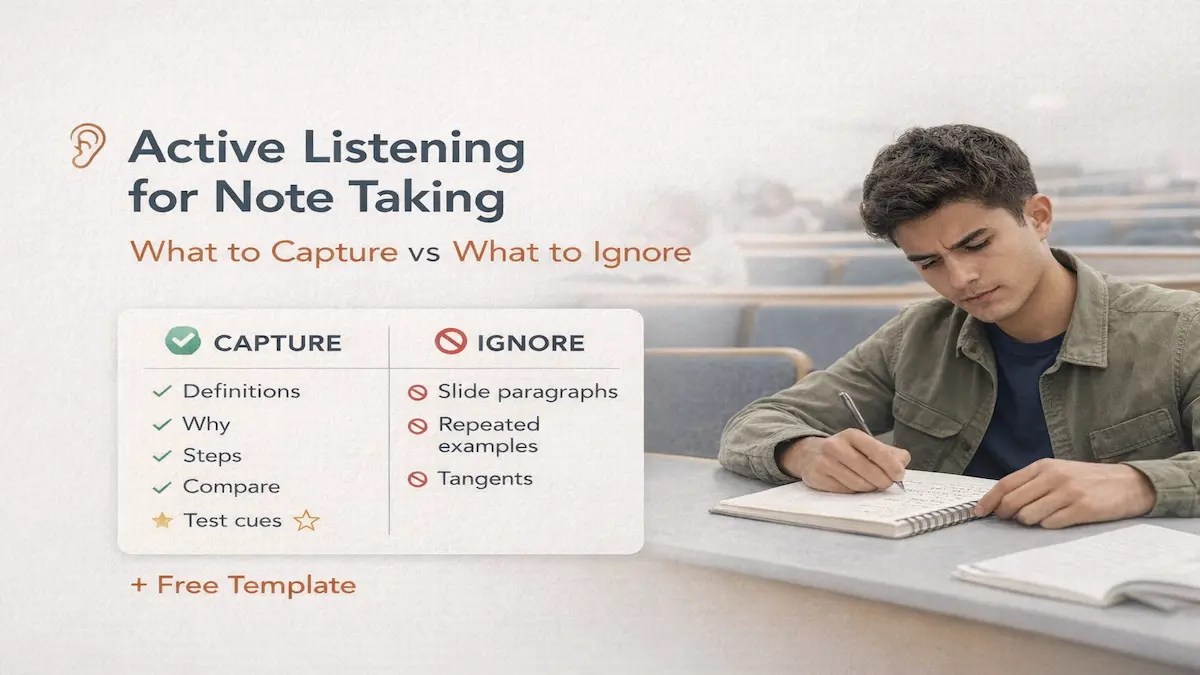
- Active Listening for Note Taking: What to Capture vs…
- Best Note Taking Apps for Students on Mac (Study…

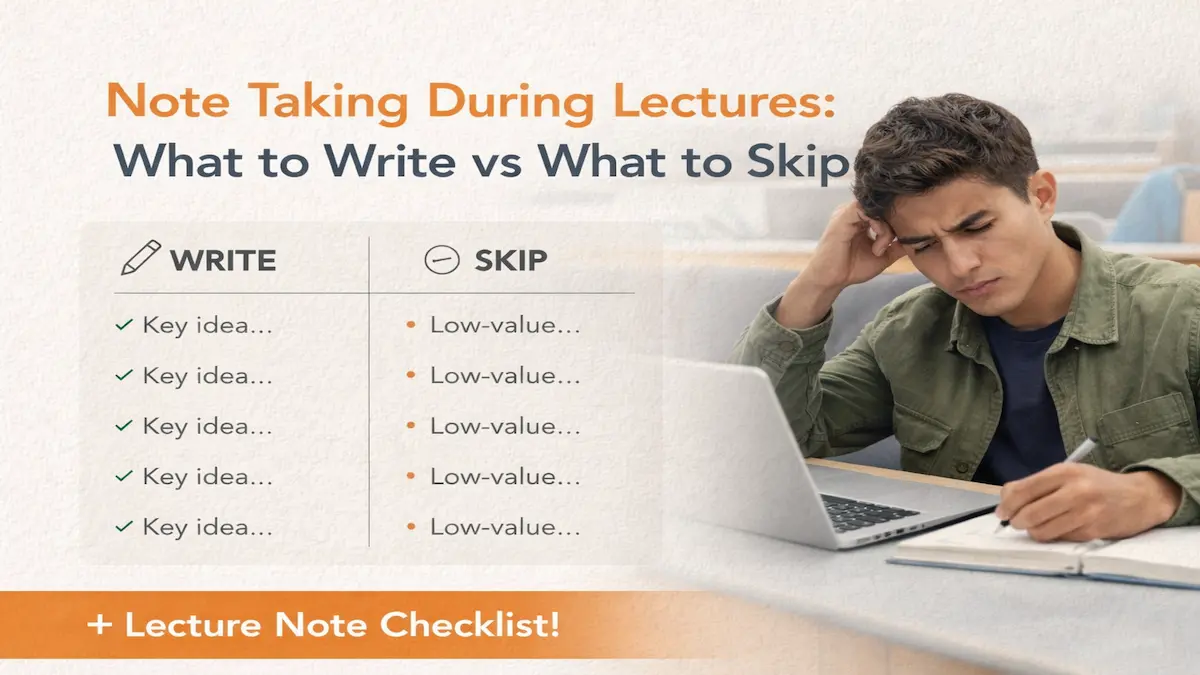
- Note Taking During Lectures: What to Write vs What to Skip
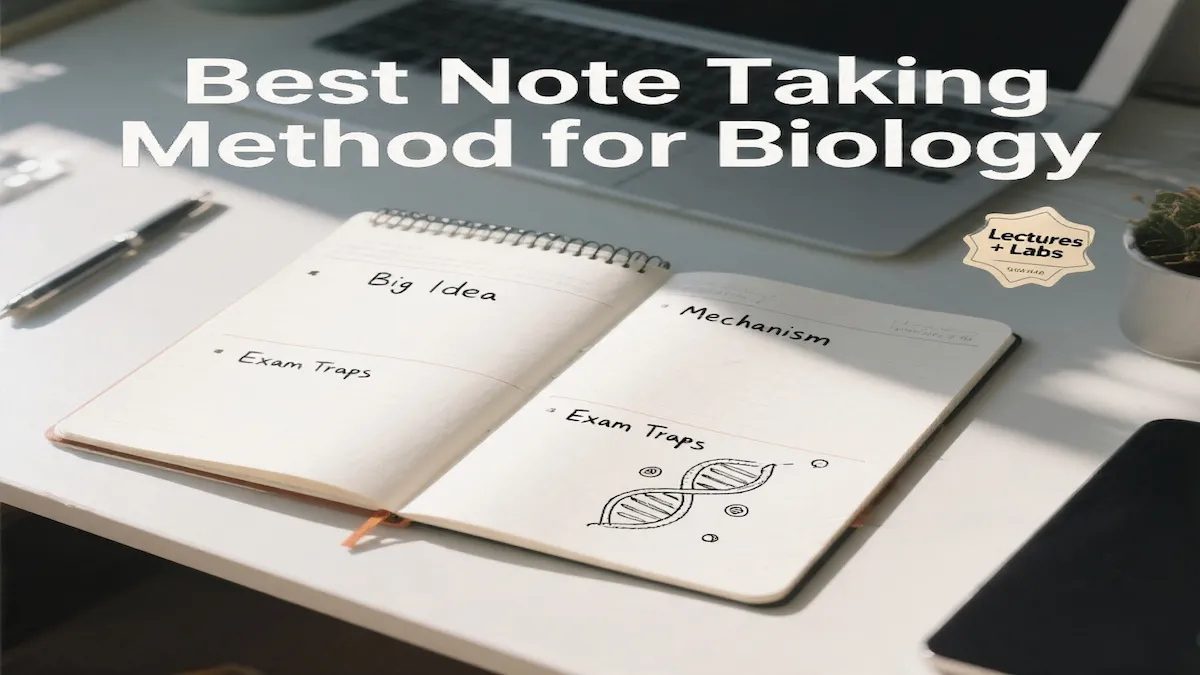
- Best Note Taking Method for Biology: Lectures + Labs System
- Concept Map vs Mind Map for Studying: What’s the…

- How to Take Notes with ADHD: A Simple, Low-Stress…