If your psych notes look “complete” but still don’t help on exam day, you’re not alone. The best note taking method for psychology isn’t the one that captures the most words—it’s the one that turns theories into test-ready understanding (not a transcript of the professor’s slides).
Here’s the simple idea: the Concept–Study–Application System (CSA) is a psychology note-taking method that captures (1) the core concept, (2) how you’ll study it using retrieval practice, and (3) how it shows up in fundamental research, cases, and exam questions. It’s built for busy college weeks—commutes, labs, part-time shifts, and midterms—so you leave psychology class with notes that already want to be studied.
This guide works for Psych 101 / Intro to Psychology through upper-division courses. If you’ve been wondering how to take notes in psychology class without copying slides—or you want a clean psychology notes template you can reuse every week—CSA is for you.
Quick Start: If you only have 10 minutes, do this
Copy the CSA template below into your notes app, then run this quick workflow right after class:
- Write one Concept sentence (plain English).
- Add 2 cues you can quiz yourself on (no looking).
- Add 1 concrete application (study, experiment, or daily life).
- Mark 1 is a confusing spot to ask in office hours.
- Do a 60-second recall: close notes, explain it out loud.
That’s the only routine you need to start.
Best Note Taking Method for Psychology: Why Notes Feel More Complex
Psychology is both concept-heavy and evidence-heavy. You’re juggling theories (conditioning, schemas, biases), research methods (variables, confounds, operational definitions), and vocabulary that sounds familiar but means something specific.
If you try to write everything, you end up with long psychology lecture notes you can’t use. If you write too little, you miss the logic behind a study. CSA fixes this by forcing every chunk of content to answer three questions:
- What is it?
- How will I learn it?
- Where does it show up?
Next step: Pick one upcoming lecture topic (memory, social influence, psychopathology) and commit to CSA for just that topic this week.
Why CSA is the best way to take notes in psychology
Most psychology exams don’t reward passive notes. You’ll be asked to explain, compare, predict, and apply—often using scenarios. CSA keeps the “definition,” the “test yourself” cues, and the “application” on the same page.
That means your notes become psychology study notes instead of raw lecture capture.
Next step: Use a consistent note title format: Course – Date – Topic – CSA. Consistency makes it easier to organize psychology notes and review quickly.
The CSA page structure (what to write in each section)
C — Concept (capture understanding, not sentences)
Write one plain-language concept sentence. Then add 2–3 key details:
- the mechanism (how it works)
- what it’s not (common confusion)
- one quick example or boundary case
S — Study (build retrieval practice into the notes)
Add cues you can answer without looking. Think:
- “Explain X in one minute.”
- “Compare A vs B.”
- “What would happen if…?”
This turns your notes into built-in flashcards—without extra work.
A — Application (connect to research and real life)
Add one of these:
- a mini study summary (who/what/measure/result)
- a real-world example (campus/work/social media)
- a short exam-style scenario
Psychology sticks when it attaches to a situation.
Next step: After your following lecture, spend 3 minutes filling S and A. Don’t postpone it—this is where the value happens.
Free CSA Template (Copy-Paste Psychology Notes Template)
Paste this into Notion, OneNote, Google Docs, Apple Notes, or a handwritten page layout.
TITLE: Topic + Date (Course – Date – Topic – CSA)

C — CONCEPT
- Concept sentence (plain English):
- Key mechanism (how it works):
- Common confusion (what students mix up):

S — STUDY (RETRIEVAL CUES)
Cue 1 (explain in 60 seconds):
Cue 2 (compare/contrast):
Cue 3 (predict/apply):

A — APPLICATION
- Study snapshot (IV, DV, key finding):
- Real-life example (1–2 sentences):
- Exam-style mini prompt (how a professor might ask it):

CONFUSIONS / OFFICE HOURS
- Question I’ll ask:
- Term I need clarified:

One-line takeaway:
-
How to use CSA during a lecture without falling behind
You don’t need perfect formatting in real time. You need a capture method that protects attention.
During class (fast + realistic)
This same capture style also works for seminar note taking when you need quick examples and clear claims.
- Write shorthand in the Concept section (keywords, arrows, quick definitions).
- Leave blanks instead of chasing every detail.
- When the professor signals importance (“this will be on the exam”), add a quick Study cue right there.
- If a slide is dense, capture the point in one line, not the paragraph—this is especially helpful in engineering lectures
Right after class (same day)
Turn your rough capture into a clean CSA page using the slide deck and your memory. This is where spaced repetition starts—because you’re revisiting content quickly while it’s still fresh.
Next step: Put a 12-minute calendar block after lecture (or after your commute) labeled “CSA clean-up.”
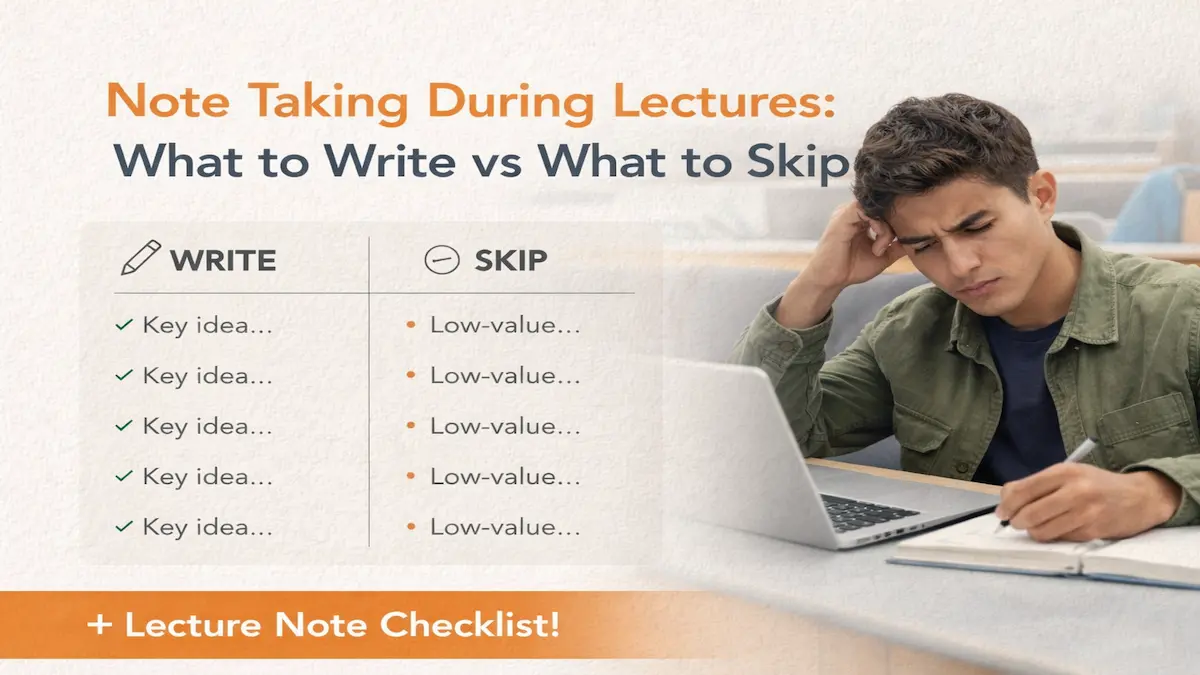
What to write vs. skip in psychology lecture notes
Write this (high-yield)
- Definitions in your own words
- The “why it matters” line (what it predicts/explains)
- Study outcomes (what changed, what didn’t)
- Classic confusions (exam traps)
- Any “compare/contrast” relationships (A vs B)
Skip this (low value)
- Full sentences from slides
- Long quotes that don’t change meaning
- Every example the professor says (keep one strong one)
- Anything you can reopen easily later (like full reading citations)
Simple rule: Write what you can test yourself on.
Example Box: Social Psychology notes (Fundamental Attribution Error)
C — Concept
People tend to over-attribute others’ behavior to personality and underweight situational forces.
S — Study cues
- Explain it in 60 seconds.
- Give a new example from campus.
- How is it different from actor–observer bias?
A — Application
A group project teammate misses a meeting—do you assume laziness, or consider a work shift, bus delay, or family issue?
Next step: Take one concept from your following lecture and write a campus-based example (dorm, cafeteria, study group, team practice).
CSA for psychology labs and research methods (where students usually struggle)
Lab content can feel “mathy” because it’s logic and measurement—similar to what students face when building general chemistry notes.
CSA prevents you from memorizing research terms without understanding design—especially with IV/DV, confounds, operational definitions, and demand characteristics.
Concept (plain English)
Define the method in your own words. Example:
“A confound is a hidden variable that changes with the IV and could explain the result.”
Study cues (research methods cues that actually show up on tests)
- Identify the IV and DV in this setup.
- What confound could explain the result?
- How would you reduce demand characteristics?
- What’s the operational definition of the key variable?
- What change would improve internal validity?
Application (use your real lab)
Summarize the lab you ran in one tight snapshot: IV, DV, procedure, key finding, and one limitation.
Next step: For every lab, create one CSA page titled “Lab: [Paradigm]” and write the IV/DV/confound line even if you think you know it.
Example Box: Cognitive lab notes (Stroop task)
C — Concept
Automatic processing can interfere with controlled attention.
S — Study cues
- What pattern of results supports interference?
- How would you operationalize reaction time?
A — Application
Suppose reaction time increases during incongruent trials, which supports the interference account. Note possible confounds (fatigue, practice effects).
The “behind / cramming / overwhelmed” plan (today + next 48 hours)
If you’re behind, the goal is not “rewrite everything.” The goal is “create a small set of high-yield CSA pages you can actually review.”
Today (60–90 minutes)
Pick the last two lectures most likely to show up on the exam (usually the most recent unit). For each lecture:
- Make one CSA page for the top 3 concepts only.
- Use the slides as a scaffold, but write the concept sentence in your own words.
Then do one closed-notes recall per page: explain it out loud like you’re teaching a friend before a quiz.
Next 48 hours (two short sessions)
- Session 1 (25 minutes): Answer only the Study cues (no rereading). Mark what you missed.
- Session 2 (25 minutes): Add one Application per missed item (study snapshot or scenario).
If you have a part-time shift, do Session 1 on your commute (audio self-explanation) and Session 2 after the change with the slide deck for quick corrections.
Next step: Choose your two sessions now and attach them to routines (after dinner, right after work, between classes).
Mini diagnostic: Is your current note system helping or hurting?
Score yourself quickly: 2 points for “Yes,” 1 for “Sometimes,” 0 for “No.”
- Can you answer the questions in your notes without looking?
- Do your notes include at least one application per central concept?
- Can you find the IV/DV/confound quickly in your lab notes?
- Do you review the same day (even 10–12 minutes)? If you’re organizing topics, concept map vs mind map can help you pick the right structure.
- Do your notes help you write short answers, not just recognize definitions?
If you scored 6 or below: switch to CSA for the following two lectures and re-score.
Key takeaways
- CSA creates study-ready psychology notes by pairing concepts with retrieval cues and real applications.
- Same-day clean-up is the difference between “notes” and “memory.”
- Lab success comes from tracking IV/DV, measurement, and confounds—not just definitions.
- If you’re behind, backfill only high-yield topics and study with closed-notes recall first.
- Use office hours strategically: bring one flagged confusion per CSA page.
- Build exam-style prompts directly from your concept sentence to practice how you’ll be graded.
FAQ
How many CSA pages should I make per week?
Aim for one CSA page per lecture topic, plus one per lab. If your course moves fast, prioritize concepts your professor repeats and anything tied to learning objectives.
Can I use CSA with an iPad or a handwritten notebook?
Yes. The structure matters more than the tool. If handwriting helps attention, keep the same three sections and add Study cues in the margin for quick self-quizzing—similar to the Cornell note-taking method layout.
What if my professor tests straight from the textbook?
CSA still works—make the Application section a “textbook case snapshot,” and make Study cues match end-of-chapter questions. You’ll still practice active recall instead of rereading.
How do I know what counts as an “application” in psychology?
A strong application is any scenario, case, or study result that uses the concept to explain behavior if you can answer “So what?” in two sentences, it counts.
Is CSA better than flashcards?
Flashcards are great, but they can detach facts from context. CSA generates flashcards naturally (from Study cues) while keeping studies, methods, and real examples connected.
How do I organize psychology notes for exams?
Use consistent titles (Course–Date–Topic), keep CSA blocks, and star the cues you missed. Those starred cues become your exam checklist.
Conclusion
If you want notes that translate into points on quizzes, lab reports, and short-answer exams, build your pages around CSA and keep them active from day one. With a consistent psychology notes template, same-day clean-up, and a few minutes of closed-notes recall, the best note taking method for psychology becomes the one you can repeat every week—even during midterms and work shifts.
Related Posts:
- Concept Map vs Mind Map for Studying: What’s the…

- Best Note Taking Method for Biology: Lectures + Labs System
- How to Take Notes in Computer Science: The…
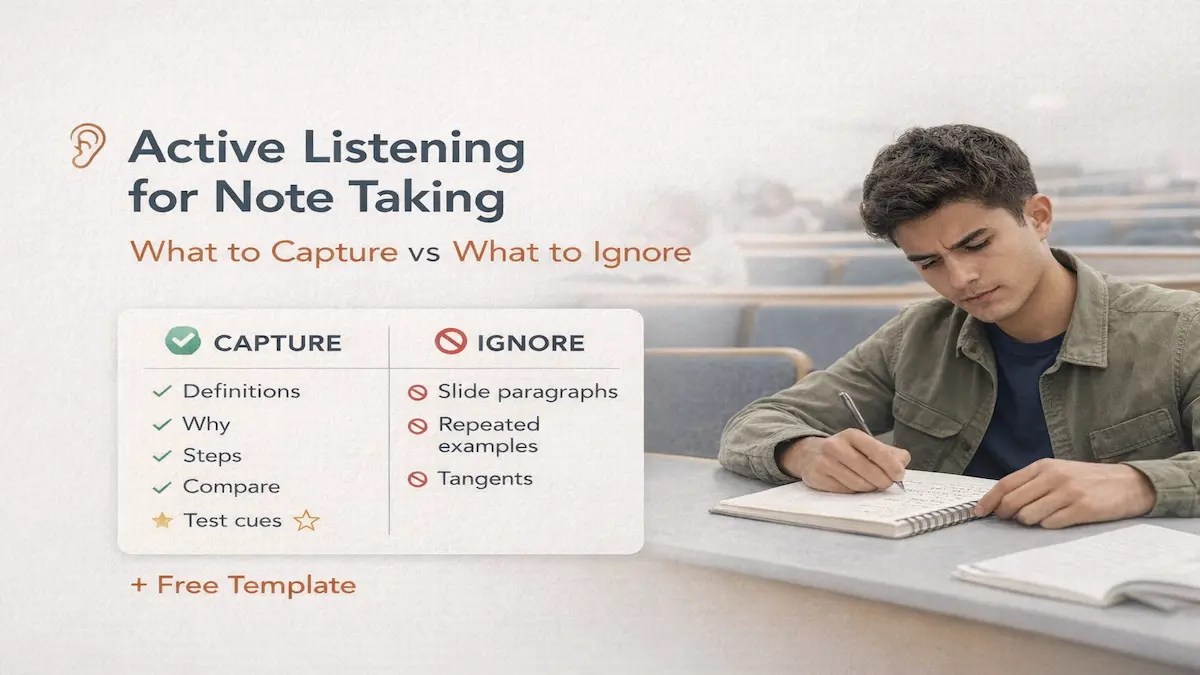
- Active Listening for Note Taking: What to Capture vs…
- Best Note Taking Apps for Students on Mac (Study…

- Note Taking During Lectures: What to Write vs What to Skip