If you’ve ever left a lecture with three pages of scribbles and zero understanding, the problem usually isn’t effort—it’s selection. Active listening for note taking is the skill of listening for meaning first, then writing only what will help you learn and perform on quizzes, labs, and exams.
Snippet-ready definition (copy/paste): Active listening for note taking is a focused way of listening that prioritizes ideas, relationships, and instructor signals so your notes capture what matters and ignore low-value detail.
This guide is for college students in the U.S. who want better lecture notes that actually turn into exam answers—whether you’re in a big lecture hall, a fast-paced STEM class, or a discussion-heavy humanities course.

Quick Start: If you only have 10 minutes, do this…
- Draw two columns: Main Ideas (left) and Evidence/Examples (right).
- In the left column, write only: definitions, “why,” steps, comparisons, and anything the professor repeats or emphasizes.
- In the right column, jot one example per idea (not all of them).
- Star anything that sounds like an exam prompt: “This is important,” “You’ll see this again,” “Common mistake,” “Key difference.”
- After class, write a 2-sentence summary at the top: “Today was about ___ because ___.”
Next step: Use the template in the Templates section for your next class and commit to skipping at least 30% of low-value words.
Active Listening for Note Taking: what it changes in your brain (and grades)
Most students try to “write faster.” But learning science suggests performance improves when you encode meaning and practice retrieval, not when you copy everything word-for-word.
When you use active listening and note-taking together, you’re constantly asking:
- “What is the main point?”
- “How does this connect to last week?”
- “What would a professor test?”
Next step: In your following lecture, aim for notes that read like a study guide—not a transcript.
What to capture vs what to ignore (simple decision rules)
Here’s the rule that saves you: Write what you can’t easily recreate later. Skip what you can.
You can always re-read the textbook, slides, or posted articles. What you can’t recreate is the professor’s emphasis, structure, and reasoning.
Think of this as selective note-taking: you’re filtering information in real time so your notes stay clean and functional.
“Write this” signals (high-value capture)
Capture information that does one of these jobs:
- Defines something (especially new vocabulary)
- Explains “why” (cause/effect, mechanisms, reasoning)
- Shows steps (processes, methods, problem-solving moves)
- Compares (A vs B, pros/cons, similarities/differences)
- Connects (links to last week, future units, real-world applications)
- Predicts assessment (what will be on quizzes/exams/labs)
Next step: Put a small symbol next to each line:
D (definition), W (why), S (steps), C (compare), L (link), T (test cue).
“Skip this” signals (low-value noise)
Ignore or minimize:
- Housekeeping (dates, room changes) unless it affects grading
- Long stories that don’t explain a concept (keep a 3–5 word label if needed)
- Repeated examples after you’ve captured one strong example
- Slide text you can access later (write the interpretation, not the paragraph)
- Tangents that don’t connect to the learning goal
Next step: If you catch yourself copying complete sentences, switch to fragments + arrows. Your job is to capture meaning, not punctuation.
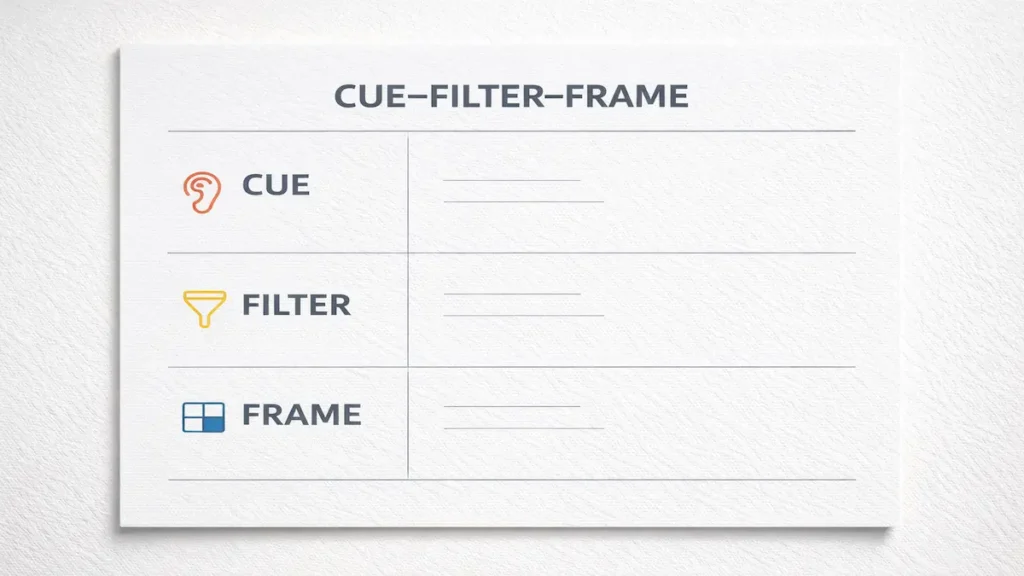
The CUE–FILTER–FRAME System (a repeatable method)
Use this system in every class. It keeps you listening first, writing second, and it works with any format (paper or laptop).
Step 1: CUE (listen for instructor signals)
Your job is to detect when the lecture shifts from “talking” to “teaching.” Cues include:
- repetition
- slowing down
- board-writing
- verbal flags (“key idea,” “common mistake,” “you’ll see this again”)
Step 2: FILTER (decide what deserves ink)
Ask one question: Would I be annoyed if this weren’t in my notes during exam review?
- If yes: write it.
- If no: skip or summarize in 5 words.
Step 3: FRAME (store it in a study-ready structure)
Write in chunks that can become flashcards or practice questions:
definition → example → common mistake → mini-question
Next step: Write “CUE / FILTER / FRAME” at the top of your notes page for two weeks until it becomes automatic.
Before class (2 minutes): set up for active listening
This is the fastest way to improve lecture note-taking without adding extra hours.
- Skim lecture slides or last class’s headings (even on your phone while walking in).
- Write 3 empty lines labeled: Today’s big questions.
- Set a rule: one page per main topic, not one page per 10 minutes.
Next step: If you commute, open the LMS and read just the slide titles. You’re priming your brain to recognize what matters.
During the lecture, a live capture flow that keeps up
Use the 3-layer note stack:
- Main idea (1 line)
- Support (1–3 bullets)
- Trigger (a test cue or question)
This is how you avoid drowning in details and stop transcribing.
Next step: When the professor starts a long explanation, force yourself to write the main idea first. Then add support.
After class: the 7-minute cleanup (high return, low effort)
Don’t rewrite everything. Just do the high-return edits:
- Add headings
- Circle definitions
- Add one “why it matters” line
- Turn starred items into 2–3 exam-style questions
Next step: Set a recurring 7-minute timer right after each lecture—before you go to your shift or your next class.
Lecture cues you can listen for (phrases that predict what matters)
Professors often tell you what to write—indirectly. Listen for these lecture cue words and transitions:
Common verbal cues:
- “The key idea is…”
- “This is the difference between…”
- “You’ll use this when…”
- “A common mistake is…”
- “Put this in your own words…”
- “If you remember one thing…”
Behavior cues:
- Writes it on the board (even briefly)
- Stops and asks a question
- Repeats the same point in a new way
- Gives an example immediately after a definition
- Refers to office hours, a rubric, or what graders look for
Next step: Star notes that follow these cues. Later, those stars become your study priority list.
Example Box: what this looks like in real classes
Example 1: Big lecture (Psych 101)
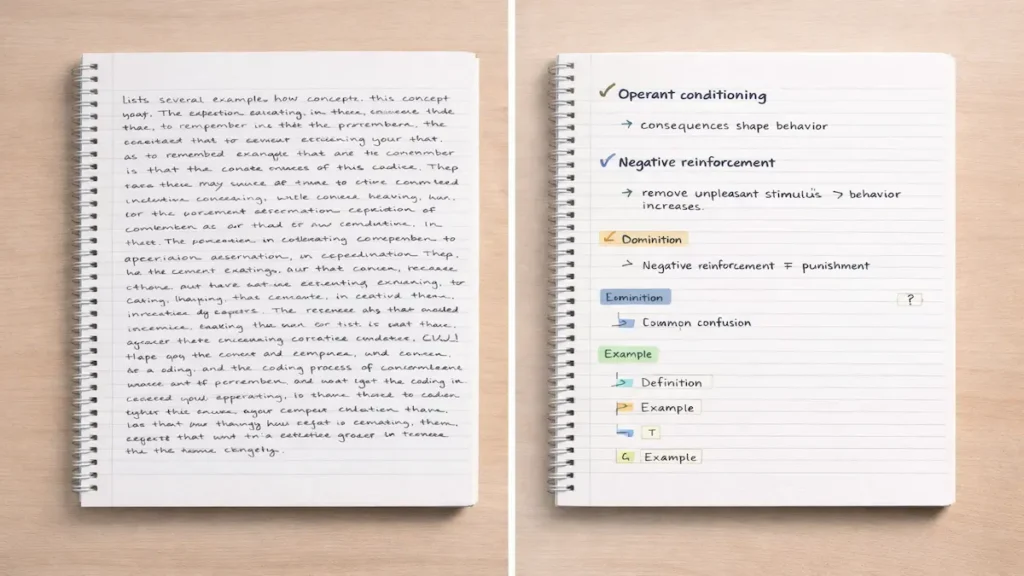
Professor says: “Operant conditioning is different from classical conditioning because it’s about consequences.”
Your notes should capture:
- Definition: operant = behavior shaped by consequences
- Compare: classical = association; operant = consequences
- Trigger: “Explain the difference + give one example”
Example 2: Lab course (Chem lab pre-brief)
TA says: “Most lab report points are lost in error analysis—don’t just list errors, explain direction and impact.”
Your notes should capture:
- Step: error analysis must include direction (higher/lower) and effect size
- Common mistake: listing errors without impact
- Trigger: “How does this error change the result?”
Example 3: Midterms week + part-time job
You missed half the lecture because you came from a 6 a.m. shift.
Active listening move: write only FRAME notes—headings + starred cues + one example each. Then use the 48-hour plan below to patch gaps.
Next step: Pick one class this week and practice writing triggers as questions (“Why does ___ happen?”) instead of copying.
When you’re behind or overwhelmed: today + next 48 hours
If you’re cramming or your notes are messy, don’t start by rewriting. Start by rebuilding the structure.
Today (30–60 minutes)
- Pull up your lecture slides + your notes side-by-side.
- Add headings that match the slide titles.
- Star 5–10 items that match cues (“key,” “difference,” “common mistake”).
- Create 3 retrieval practice questions from starred items.
Next 48 hours (two short sessions)
Session A (25 minutes):
Answer your 3 questions without notes. Then check notes and fix gaps.
Session B (25 minutes):
Make a mini “exam sheet” from your notes: definitions + comparisons + steps.
Next step: If you can only do one thing, do Session A. Testing yourself beats rewriting.
Mini diagnostic quiz: Are you listening actively or transcribing?
Score yourself based on your last lecture notes. Give yourself 1 point for each “yes”:
- I have clear headings for each topic.
- I wrote at least 3 definitions in my own words.
- I captured at least 2 comparisons (A vs B).
- I included at least 3 “why/how” explanations.
- I starred or labeled instructor emphasis.
- I wrote at least 3 questions I could study from.
- I can summarize the lecture in 2 sentences using my notes.
Scoring:
- 0–2: You’re transcribing. Start with CUE–FILTER–FRAME next class.
- 3–5: You’re halfway there. Add triggers as questions.
- 6–7: You’re building study-ready notes. Focus on cleanup and spaced repetition.
Next step: Retake this quiz after your following lecture to see if your note quality improves.
Common student mistakes (and quick fixes)
- Copying slide paragraphs → Write what the professor adds: the explanation, not the text.
- Writing examples forever → Capture one strong example, then label the rest with 3–5 words.
- No headings → Add headings during transitions (or in the first minute).
- Never revisit notes → Do the 7-minute cleanup the same day.
- Trying to be perfect → Use fragments, arrows, and abbreviations; clarity comes in cleanup.
Next step: Choose one mistake to fix this week. One improvement at a time is sustainable.
Templates
A) Capture vs Ignore Checklist (bring to lecture)
Capture (write it down):
- Definitions in your words
- “Why” explanations
- Steps/processes
- Comparisons
- Instructor emphasis
- Common mistakes + fixes
Ignore/minimize:
- Slide text you can access later
- Long stories with no concept
- Duplicate examples
- Housekeeping (unless graded)
B) Free Note Template (copy/paste)
Header
Course: ___
Date: ___
Topic: ___

Today’s Big Questions (before class)

Main Ideas (left column)
Idea 1: ___ (D/W/S/C/L/T)
Support: ___
Trigger question: ___

Idea 2: ___ (D/W/S/C/L/T)
Support: ___
Trigger question: ___

Examples (right column)
Example for Idea 1: ___
Example for Idea 2: ___

After-class 2-sentence summary
Today’s lecture was about ___.
This matters because ___.
C) Quick scripts you can use (in class or office hours)
In class (when lost): “What’s the main idea of this section?” (write the answer as a heading)
Office hours: “What are the top 3 concepts you expect us to explain, not just recognize?”
Study group: “Let’s turn our starred items into practice questions.”
Next step: Paste the template into Google Docs/Notion and duplicate it for every lecture.
Key takeaways
- Listen for meaning first; write for future studying, not for a transcript.
- Capture definitions, “why,” steps, comparisons, links, and test cues.
- Skip slide paragraphs, repeated examples, and tangents that don’t teach a concept.
- Use the CUE–FILTER–FRAME system to make quick decisions and stay caught up.
- Do a 7-minute cleanup the same day to turn notes into retrieval practice.
- If you’re behind, rebuild the structure and test yourself instead of rewriting.
FAQ
How do I take notes if the professor talks too fast?
Start with headings and write only the main ideas first. Use fragments and symbols, then fill gaps during the 7-minute cleanup using slides or a classmate’s outline.
Should I write down everything on the slides?
Usually no. Slides are easy to re-access. Your notes should capture what the instructor explains, emphasizes, or connects—especially “why,” steps, and comparisons.
What if I miss a section because I zoned out?
Add a heading like “Gap,” then patch it later using slides, a recording (if allowed), or a friend’s notes. Turn the patched section into two practice questions.
Is typing or handwriting better for active listening?
Either can work if you avoid verbatim copying. Typing can tempt transcription; handwriting can slow you down. Use the same structure (main idea → support → trigger) either way.
How do I use these notes to study for exams?
Focus on starred items and trigger questions. Convert them into flashcards or short practice prompts and review them with spaced repetition across the week.
Conclusion
Better notes aren’t about writing more—they’re about listening smarter. When you train yourself to spot cues, filter quickly, and frame ideas as study-ready chunks, lectures stop feeling like a firehose and start feeling like a roadmap. Try the CUE–FILTER–FRAME system in your next class and use active listening for note taking to build notes you can actually learn from.