
If your notes look “full” but studying still feels hard, it’s usually not because you’re lazy or “bad at studying.”
- Quick Method Picker (Choose in 60 Seconds)
- Mini Quiz: Find Your Best Note-Taking Method
- What Great Notes Actually Do (Science-Backed, Not Academic)
- 1) Cornell Notes Method (Best for revision + exams)
- 2) Outline Method Notes (Best for structured lectures)
- 3) Mind Mapping for Studying (Best for connected ideas)
- 4) Charting Method Notes (Tables) — Best for comparisons
- 5) Sentence Method (Fast lecture survival)
- 6) Boxing Method Notes (Best when lectures jump topics)
- 7) Flow Notes (Best for processes + cause/effect)
- 8) Sketch Notes (Best for diagrams + visual learners)
- 9) Q&A Notes (Study like an exam)
- 10) Timeline Notes (Best for history + case studies)
- Quick Comparison Table (Choose Even Faster)
- MCQ / Multiple Choice Exams
- Essay / Written Exams
- Problem-Solving Exams (Math/Physics/Engineering)
- Open-Book Exams
- After Class (10 minutes)
- Weekly Review (30 minutes)
- Before Exams (90-minute plan)
- Final tip
It’s because your notes don’t match the lecture type.
Some lectures are structured and calm. Others are fast and chaotic. Some are heavy on comparisons, while others focus on processes, diagrams, or case studies. There isn’t one “perfect” approach—what matters is choosing the right style for the lecture and turning your notes into easy revision.
In this guide, you’ll learn note-taking methods for students and exactly when to use each one, plus a simple set of lecture note-taking strategies you can apply in any class.
In this guide, you’ll get:
- A 60-second method picker (so you stop guessing)
- The most useful note-taking methods for college students with clear “use this when…” rules
- A simple way to build exam-ready notes using active recall and spaced repetition (without academic language)
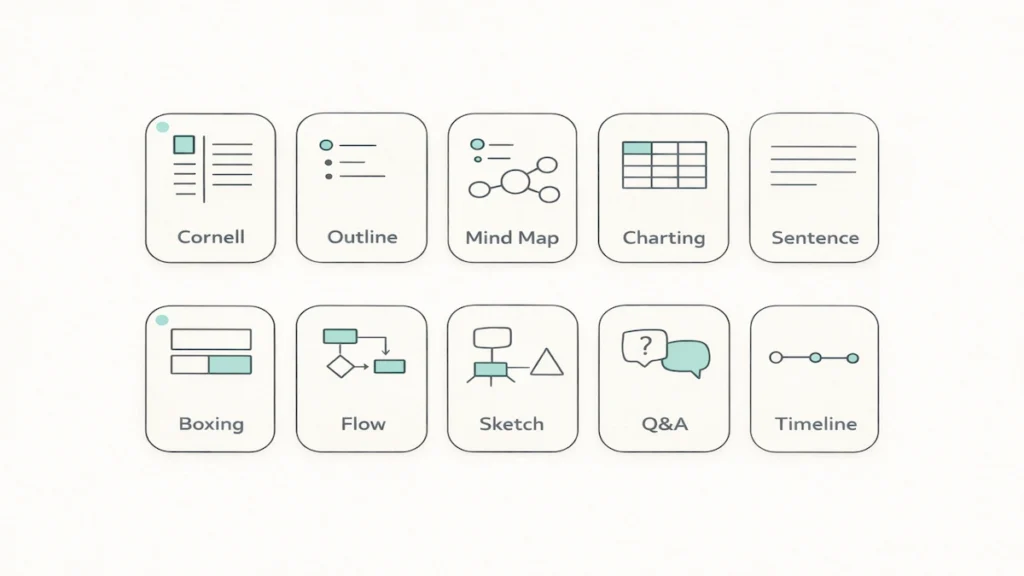
Quick Method Picker (Choose in 60 Seconds)
- Structured lecture with clear headings → Outline method notes
- You want notes that become exam questions → Cornell notes method
- Lots of comparisons (types/pros/cons/differences) → Charting method notes
- Concepts connect (theories/frameworks/systems) → Mind mapping for studying
- Fast lecturer / messy lecture → Sentence method
- Processes/steps/algorithms/cause-effect → Flow notes
- Diagrams (bio/anatomy/engineering) → Sketch notes
- History/development over time → Timeline notes
- You learn best by self-testing → Q&A notes
- Lecture jumps between topics → Boxing method notes
Default combo that works in most classes:
During class: Outline (or Sentence if it’s fast) → After class: add Cornell-style questions + a summary.
Mini Quiz: Find Your Best Note-Taking Method
Answer fast—no overthinking:
- Is the lecture mostly structured or random?
- Is it mostly explaining ideas or comparing options?
- Do you need steps/process or definitions/examples?
- Is the content visual (diagrams) or mostly words?
- What’s the exam style: MCQ / essays / problem-solving / open-book?
Simple results:
- Structured + words → Outline method notes or Cornell notes method
- Comparisons → Charting method notes
- Connected concepts → Mind mapping for studying
- Fast + messy → Sentence method (then clean up)
- Steps/process → Flow notes
- Diagrams → Sketch notes
- History/cases over time → Timeline notes
- Exam focus → Cornell notes method + Q&A notes
What Great Notes Actually Do (Science-Backed, Not Academic)
Strong notes do three jobs:
- Capture the lecture without falling behind
- Organize ideas so you can find them instantly
- Convert into revision (questions, summaries, flashcards)
And here’s the key: rereading notes feels productive, but the real improvement usually comes from:
- Active recall (testing yourself instead of just rereading)
- Spaced repetition (reviewing again later instead of cramming)
So any note-taking system for students should help you self-test and review at the right times.
The 10 Best Note-Taking Methods (And When to Use Each)
1) Cornell Notes Method (Best for revision + exams)
The Cornell notes method is one of the best note-taking methods for university students because it naturally turns your notes into study questions.
How it works (simple layout):
- Notes column: key ideas + explanations + examples
- Cue column: keywords + questions (your self-quiz)
- Summary: 5–7 lines at the bottom
Use the Cornell notes method when:
- Your exam requires “why/how” answers
- The lecture includes definitions plus examples
- You want exam-ready notes from day one
Avoid the Cornell notes method when:
- The lecture is mostly comparisons (tables are faster)
- The lecture is mostly diagrams (sketch notes fit better)
Mini example (cue questions you can write):
- What is X?
- Why does it matter?
- What’s the difference between X and Y?
- Give one real example.
2) Outline Method Notes (Best for structured lectures)
Outline method notes are perfect when the lecturer is organized, and you can hear clear headings and subheadings. It’s a classic lecture note-taking method because it’s fast, tidy, and easy to revise.
Use outline method notes when:
- The lecturer teaches in main points and subpoints
- The topic has a clear structure
- You want clean notes without overthinking
Avoid outline method notes when:
- The lecture jumps between topics a lot
- You need to see connections more than order (mind mapping helps more)
Student tip: keep it to three levels:
Main idea → sub idea → example
3) Mind Mapping for Studying (Best for connected ideas)
Mind mapping for studying is one of the best note-taking methods for college students when the goal is to understand how ideas connect. It’s especially useful for theories, frameworks, and “big picture” revision.
Use mind mapping for studying when:
- Concepts connect (systems, frameworks, cause links)
- You want a one-page chapter summary
- You’re revising and need the big picture
Avoid mind mapping for studying when:
- The lecture is extremely detailed (it gets crowded)
- You need step-by-step problem-solving (flow notes are better)
Best strategy: take lecture notes first, then create a mind map as a revision sheet.
4) Charting Method Notes (Tables) — Best for comparisons
Charting method notes are table-based notes that facilitate comparisons. This is ideal for “types of…”, pros/cons, and anything where differences matter (especially MCQs).
Use the charting method notes when:
- The lecture compares models, types, approaches, or categories
- You need to spot differences quickly
- You’re studying for MCQs
Reusable table columns:
Type | Definition | Key Features | Example | Pros | Cons
Avoid charting method notes when:
- The topic is a story or an argument
- The content doesn’t fit into neat columns
5) Sentence Method (Fast lecture survival)
The sentence method is the “catch everything first” method. You write one idea per line as fast as you can. It’s one of the best note-taking methods for university students when the lecture speed is the main problem.
Use the sentence method when:
- The lecturer is fast, and you can’t organize live
- The lecture feels chaotic
- You need speed more than structure
Important rule: never leave sentence notes raw.
You’ll clean them up after class using a quick routine (shown later).
6) Boxing Method Notes (Best when lectures jump topics)
Boxing method notes: split your page into boxes; each box is a mini topic. This is perfect when lecturers bounce between topics, because your notes stay organized.
Use boxing method notes when:
- The lecture jumps from topic A to B to A again
- You want revision in chunks you can scan
Avoid boxing method notes when:
- The content is a strict sequence (flow notes work better)
Tip: Label every box with a clear mini-title.
7) Flow Notes (Best for processes + cause/effect)
Flow notes use arrows, steps, and decision paths. They’re ideal for processes, systems, and “if this happens, then that happens” content.
Use flow notes when:
- You’re learning steps, processes, or algorithms
- Exam questions ask “Explain how…”
- The topic follows cause-and-effect patterns
Avoid flow notes when:
- The lecture is mostly a definition list without a process
Simple flow shapes you can copy:
- A → B → C
- If X → do Y / else Z
8) Sketch Notes (Best for diagrams + visual learners)
Sketch notes are visual notes: quick drawings, arrows, and labels. You do not need to be an artist. For diagram-heavy courses, sketch notes can be one of the best note-taking methods for university students.
Use sketch notes when:
- The diagram is central to the topic
- You need to remember parts, structures, or systems
- Visual memory helps you more than long text
Avoid sketch notes when:
- The exam is essay-heavy and needs lots of writing (use Cornell/Outline alongside)
Student tip: add 1–2 lines of explanation per diagram part.
9) Q&A Notes (Study like an exam)
Q&A notes are a simple way to study with active recall. You write questions as you learn, then answer them later during revision.
Use Q&A notes when:
- You want built-in self-testing
- The course is conceptual and exam-heavy
- You learn best by quizzing yourself
Simple version: write questions in the margin during class, answer them after class.
10) Timeline Notes (Best for history + case studies)
Timeline notes put events or stages in order. They’re perfect for history, case development, and “how something changed over time.”
Use timeline notes when:
- The topic is a sequence of events
- You’re studying case studies or historical development
Avoid timeline notes when:
- The topic is not sequential
Quick Comparison Table (Choose Even Faster)
| Method | Best for | Strongest benefit | Not great when |
|---|---|---|---|
| Cornell notes method | Exams + revision | Turns notes into questions | Mostly diagrams/comparisons |
| Outline method notes | Structured lectures | Fast + tidy | Lecture jumps topics |
| Mind mapping for studying | Connected ideas | Big picture revision | Too detailed / step-by-step |
| Charting method notes | Comparisons | Differences become obvious | Doesn’t fit in columns |
| Sentence method | Fast lectures | Capture quickly | If you don’t clean up |
| Boxing method notes | Jumping lectures | Chunked revision | Strict sequences |
| Flow notes | Processes | Reproducible steps | Pure memorization lists |
| Sketch notes | Diagrams | Visual memory | Text-heavy essay only |
| Q&A notes | Active recall | Self-testing built in | Very fast lectures live |
| Timeline notes | History/cases | Order becomes clear | Non-sequential topics |
Best Method by Exam Type
MCQ / Multiple Choice Exams
Best combo: Charting method notes + Cornell notes method
Tables help you see differences, and Cornell cue questions help you test yourself.
Essay / Written Exams
Best combo: Cornell notes method + Outline method notes
You need definitions, examples, and a structure for long answers.
Problem-Solving Exams (Math/Physics/Engineering)
Best combo: Flow notes + worked examples
You need steps and patterns, not paragraphs.
Open-Book Exams
Best combo: Outline method notes + quick indexing
Speed matters. You’re searching, not rereading.
Best Method by Subject
- Business / Management / Marketing: Outline method notes + Charting method notes
- Law / Politics / Sociology: Cornell notes method + Charting method notes
- Medicine / Biology: Sketch notes + Cornell notes method
- Engineering / Computer Science: Flow notes + Outline method notes
- History / Case Studies: Timeline notes + Cornell notes method
- Languages / Literature: Cornell notes method + Q&A notes
The Note-Taking Workflow That Builds Long-Term Results
Methods are tools. Workflow is the system.
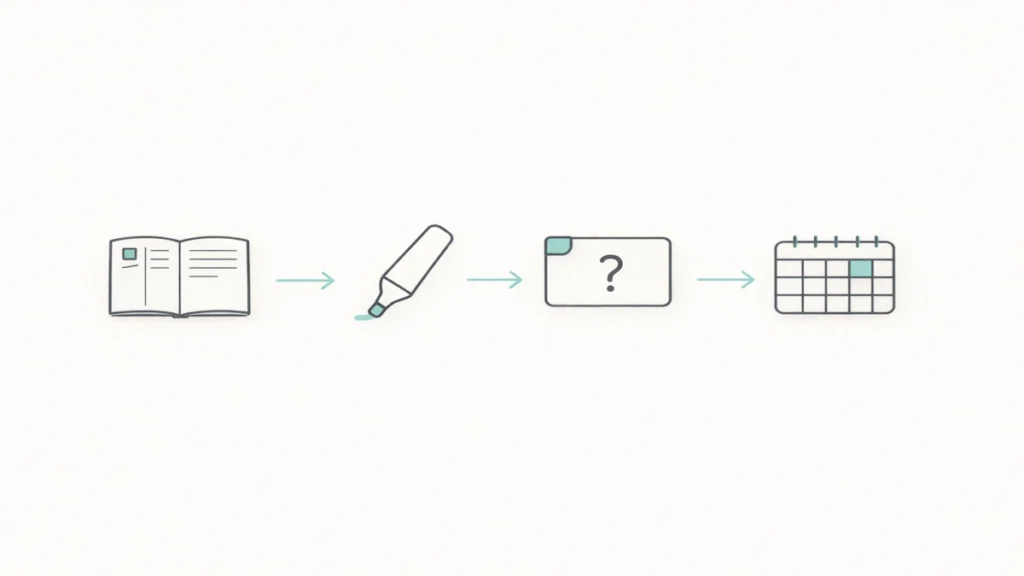
After Class (10 minutes)
Do this the same day:
- Add 3–5 headings
- Highlight keywords (terms, formulas, definitions)
- Write a 5–7 line summary
- Create 5 cue questions (active recall)
- Star ⭐ anything “exam-likely.”
This turns lecture notes into study notes.
Weekly Review (30 minutes)
Once a week:
- Skim each lecture summary
- Answer your cue questions without looking
- Update a one-page mind map or a chart table for the week’s topic
Before Exams (90-minute plan)
- Create a 1–2 page revision sheet (mind map or charting table) per topic
- Turn headings into questions
- Self-test (active recall)
- Review again later (spaced repetition)
Digital vs Handwritten Notes (Quick Decision)
Both can work. Choose based on the lecture:
- Fast lecture → type during class, then clean up + summarize
- Concept-heavy lecture → handwritten Cornell or outline notes
- Diagram-heavy lecture → handwritten sketch notes
- Hybrid win → photos of slides + your own summary (your words matter)
Common Note-Taking Mistakes (And Easy Fixes)
- Copying every word → write keywords + one example instead
- Never revisit notes within 24 hours → do the 10-minute routine
- Using one method for every subject → use the Quick Method Picker
- Pretty notes, weak studying → turn headings into questions (active recall)
- No examples → add one real example per key idea
FAQ
What is the best note-taking method for university students?
There isn’t one best method for everyone. Many students use the outline method for structured lectures and the Cornell notes revision method because Cornell notes turn into questions and summaries that are easy to study.
Is the Cornell notes method better than the outline method?
Cornell is usually better for studying later because it includes a question column and a summary section. An outline is better for capturing structured lectures quickly during class.
How do I take notes in fast lectures?
Use the sentence method during class to capture key ideas quickly. After class, spend 10 minutes organizing the notes into outline notes or adding Cornell-style questions and a summary.
How do I study from my notes effectively?
Use active recall and spaced repetition. Turn headings into questions, test yourself without looking at the notes, and review again later. Cornell notes are especially helpful because the cue column is designed for self-quizzing.
Final tip
If you want long-term results, don’t just take notes—build a system: capture → clean up → self-test → review later. That’s how the best note-taking methods for university students turn into better grades.