
If you’ve ever highlighted half a novel and still stared at a blank page during essay week, your notes aren’t the problem—you just don’t have a system that converts reading into argument.
- Quick Start: If you only have 10 minutes, do this…
- Why do English Literature notes feel harder than other classes?
- How to Take Notes for English Literature with the Quote–Theme–Device System
- The QTD Note Template (free, copy/paste)
- Where to use QTD notes: reading, lecture slides, seminar discussion
- What to highlight when reading literature (without over-highlighting)
- Example Box: A complete QTD note (novel)
- Example Box: A complete QTD note (poem)
- Example Box: A complete QTD note (play + performance detail)
- The “Behind and Overwhelmed” action plan (today + next 48 hours)
- Mini-quiz: Are your notes essay-ready?
- Common student mistakes (and quick fixes)
- Templates and mini-tools
- Key takeaways
- FAQ
- Conclusion
How to take notes for English literature isn’t about copying plot points. It’s about collecting evidence and writing down the thinking you’ll need later, when you’re tired, busy, and the exam is in 36 hours.
Snippet-ready definition: Good English literature notes capture a meaningful quote, connect it to a theme claim, and explain the literary device and effect—so you can build analysis paragraphs quickly for essays and exams.
If you’re looking for the best method for taking notes in literature classes, QTD keeps every entry paragraph-ready for essays and exams.
Who this is for: college students juggling readings, lecture slides, discussion sections, a commute, or a part-time shift—who want literature notes that actually become thesis-driven writing.
Next step: Open a doc (or your notebook) and create a page titled “QTD Notes”. You’ll paste the template from this article in the next section.
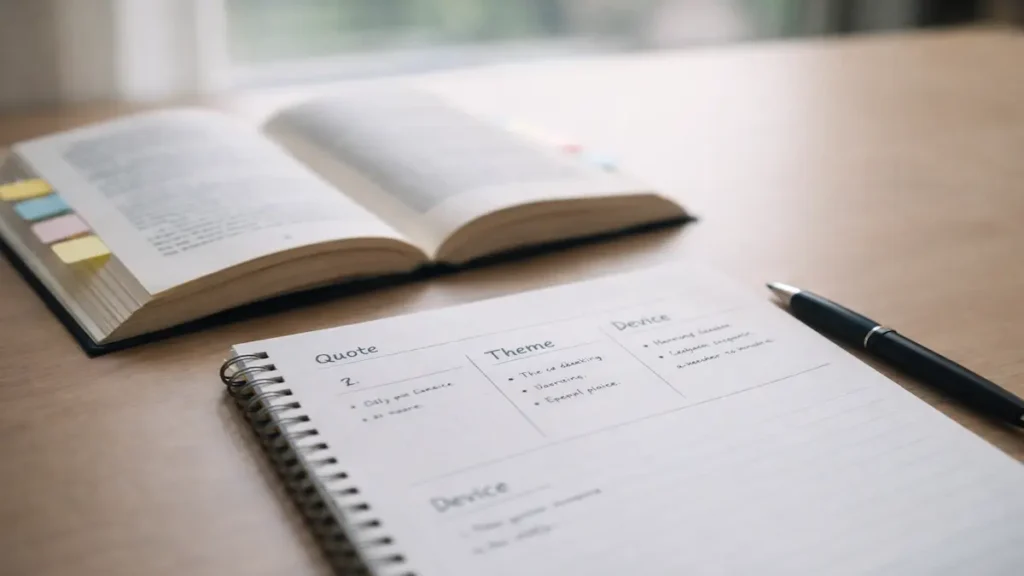
Quick Start: If you only have 10 minutes, do this…
- Pick one scene/page/poem stanza from today’s reading.
- Write one quote (2–4 lines max) and note the speaker + situation.
- Write a theme claim starting with “The text suggests that…”
- Name one device (imagery, diction, syntax, metaphor, irony, etc.) and its effect.
- Add a So What sentence: “This matters because…”
You now have one essay-ready note. Repeat once more tomorrow.
Why do English Literature notes feel harder than other classes?
In a biology lab, your notebook has clear categories: procedure, data, results, and conclusion—unlike psychology notes, where you still need a structure that turns ideas into arguments.
In English literature class, it’s easy to write “cool quote” or “interesting symbol” and move on.
But essays and exam revision demand something more specific:
- a claim you can defend,
- evidence that’s easy to locate,
- analysis that explains how language creates meaning.
Next step: Stop taking “summary notes” as your default. Use a structure that forces interpretation rather than just recall.
How to Take Notes for English Literature with the Quote–Theme–Device System
The Quote–Theme–Device (QTD) System is a repeatable literature note taking method for turning every note into a paragraph-ready chunk.
Step 1: Capture the quote (with context)
A quote without context is a time-waster later. Always add the “where/when/why.”
Write:
- the quote (short),
- page/line number,
- speaker (if relevant),
- What’s happening in the moment.
Next step: Limit yourself to 2–4 lines per quote. If it’s longer, you’ll avoid using it.
Step 2: Name the theme claim (not just a topic)
“Love” isn’t a theme. “Love requires self-deception” is.
Use a claim stem:
- “The text suggests that…”
- “This moment argues that…”
- “The author critiques…”
Next step: Make your theme sentence arguable, not factual.
Step 3: Identify the device and its effect
Devices are not a scavenger hunt. Don’t just label “metaphor.” Explain what it does—this “explain the effect” mindset is exactly what makes organic chemistry notes useful, too.
Quick device → effect pairs:
- diction → creates a cold, clinical tone
- syntax → speeds urgency or slows for reflection
- imagery → makes an abstract idea bodily and vivid
- irony → exposes a gap between belief and reality
Next step: Add one phrase: “This works by…” and finish the sentence.
Step 4: Add a “So What” sentence you can paste into an essay
This is the line that saves you during midterms week.
So What stems:
- “This matters because it reveals…”
- “It pushes the reader to…”
- “It reframes the character as…”
Next step: Write your So What as if it’s the final sentence of a body paragraph.
The QTD Note Template (free, copy/paste)
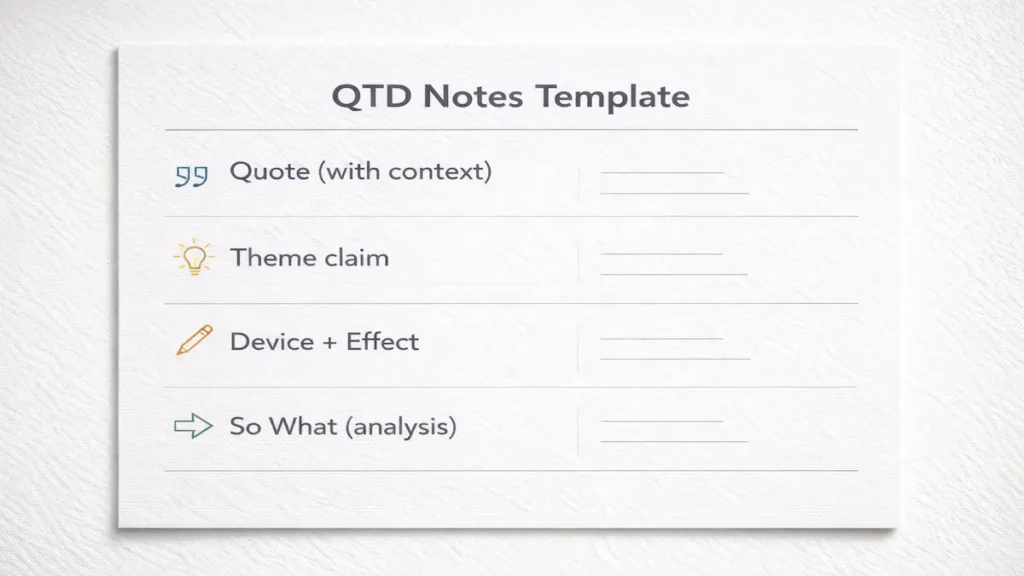
Copy this into Google Docs, Notion, or your notebook page. (This also works as a close reading notes template or quote log template.)
QTD NOTE (1 entry)

Text + location: (Title, page/line/act.scene)
Moment/context: (1–2 sentences: what’s happening)
Quote: “...”

Theme claim: The text suggests that...

Device(s): (choose 1–2)
Effect (how it works): This works by...

So What (analysis you can reuse): This matters because...

Connections: (lecture idea / historical context / another scene)
Essay use: (Possible topic sentence or question this helps answer)
Next step: Make this a repeating template so each reading session produces 2–5 QTD entries.
Where to use QTD notes: reading, lecture slides, seminar discussion
During reading (the 2-pass approach)
Pass 1 (read): light annotations only—circle confusing lines, star big moments.
Pass 2 (mine for QTD): choose 2–3 moments most likely to matter for themes, character shifts, or structure.
Next step: If you’re short on time, skip “pretty annotations” and go straight to 2 QTD entries.
During lecture
Lectures often give you what essays need: interpretive frames, key tensions, and vocabulary—and you can apply the same idea in engineering lectures by capturing claims, method, and evidence.
Turn lecture into QTD:
- “Professor’s claim” → your theme claim
- The passage discussed → your quote
- The technique discussed → your device/effect
Next step: On your lecture slides/notes, mark “QTD” next to any passage the professor returns to.
During the discussion section
Use QTD to speak confidently without rambling—especially for seminar note taking where you need quick, evidence-based comments.
Quick discussion move:
Quote → claim → device → so what
That’s an analysis mini-paragraph out loud.
Next step: Before the section, pick 1 QTD entry and practice saying it in 20 seconds.
What to highlight when reading literature (without over-highlighting)
Highlighting isn’t the enemy—highlighting too much is.
Use this rule:
- Highlight only lines you’re willing to turn into a complete QTD note.
- If you highlight, you must add one margin tag: Theme? Device? Why does it matter?
Next step: Cap yourself at 3 “convert-to-QTD” quotes per reading.
Example Box: A complete QTD note (novel)
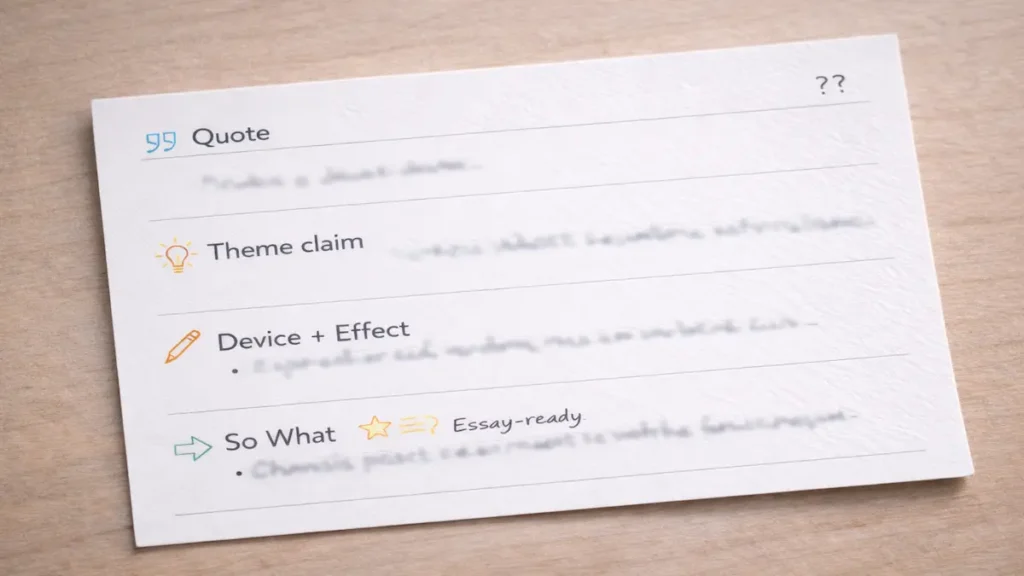
Text + location: Novel, p. 87
Moment/context: The narrator describes the family home right after a conflict.
Quote: “The hallway swallowed our footsteps, leaving only the clock’s thin complaint.”
Theme claim: The text suggests that home can become a space of emotional surveillance rather than a place of comfort.
Device(s): personification + auditory imagery
Effect (how it works): This works by giving the house predatory agency (“swallowed”) while reducing sound to a fragile, accusing tick.
So What: This matters because it frames the family tension as structural and inescapable, not just a temporary argument.
Connections: Lecture idea about “domestic gothic” and spaces that record conflict.
Essay use: Topic sentence: “The novel turns ordinary interiors into instruments of control.”
Next step: Notice how this entry already contains a topic sentence and a mini-argument.
Example Box: A complete QTD note (poem)
Text + location: Poem, lines 9–12
Moment/context: The speaker shifts from description to judgment.
Quote: “I kept the daylight in a jar / until it soured into salt.”
Theme claim: The poem suggests that trying to preserve happiness can distort it into bitterness.
Device(s): metaphor + tonal shift
Effect (how it works): This works by transforming “daylight” into something stored and rotting, then snapping into harsh taste language (“salt”) to signal regret.
So What: This matters because the poem treats memory as an active force that changes what it holds, not a neutral archive.
Connections: Compare to the earlier image of “open window” to show contrast.
Essay use: Exam answer on imagery: “Images of preservation become images of decay.”
Next step: For poetry, always track the turn (where the poem changes direction). That’s where thesis statements live.
Example Box: A complete QTD note (play + performance detail)
Text + location: Play, Act 2, Scene 1
Moment/context: Character A reassures Character B while the stage directions show hesitation.
Quote: “Of course I trust you.” (pause)
Theme claim: The play suggests that trust is often performed verbally while undermined physically.
Device(s): dramatic pause + subtext
Effect (how it works): This works by letting the pause contradict the line, so the audience reads sincerity and doubt at once.
So What: This matters because stagecraft creates meaning beyond dialogue (a pure plot summary would miss this).
Connections: Discussion about staging choices; compare to the later silence in Act 3.
Essay use: Paragraph on how performance cues create irony.
Next step: For drama, record at least one stage direction/performance clue in each major scene you note.
The “Behind and Overwhelmed” action plan (today + next 48 hours)
When you’re behind, the goal isn’t “finish everything perfectly.” It’s to build enough quote bank and analysis inventory to write and test well.
Today (60–90 minutes)
- Skim lecture notes/slides and mark 3 passages the instructor emphasized.
- Create 3 QTD entries from those passages.
- Read one key chapter/poem and create 2 QTD entries.
That’s five usable chunks of analysis.
Next 48 hours (two short sessions)
- Session A: Create 6 more QTD entries (3 from reading, 3 from lecture/discussion).
- Session B: Turn two QTD entries into two body paragraphs (rough drafts are fine).
Next step: Put these sessions on your calendar around real life: after your commute, before your shift, during a library gap.
Mini-quiz: Are your notes essay-ready?
Use this checklist on your latest 5 notes. Give yourself 1 point for each “yes”:
- I can locate the quote fast (page/line + context).
- My theme sentence is arguable (someone could disagree).
- I name a device and describe its effect.
- My So What line could be pasted into an essay paragraph.
- I have at least one connection to the lecture/discussion.
Scoring
- 0–2: You’re collecting highlights, not analysis. Start QTD immediately.
- 3–4: You’re close—tighten the effect + So What lines.
- 5: Your notes are essay-ready. Start outlining.
Next step: Fix one low-scoring note by rewriting only the theme claim and So What line.
Common student mistakes (and quick fixes)
- Highlighting too much
- Fix: Cap yourself at 3 quotes per reading that become complete QTD entries.
- Writing theme as a single word (“power,” “identity”)
- Fix: Turn it into a claim: “The text argues that power depends on…”
- Listing devices without explaining them
- Fix: Add “This works by…” and finish the sentence.
- Ignoring lecture frames
- Fix: Put “Lecture connection:” in every entry—even if it’s one phrase.
- Taking plot notes when the task is analysis
- Fix: Keep plot to 1 line of context, then move to QTD.
Next step: Pick one mistake you know you make and write it at the top of your notes page as a reminder.
Templates and mini-tools
Reading session checklist (fast)
- Choose 1–2 key moments
- Write 2 QTD entries
- Add 1 connection (lecture or earlier passage)
- End with 1 possible essay question
Weekly mini-plan (works during midterms)
- Mon/Wed/Fri: 2 QTD entries from reading
- Tue/Thu: 2 QTD entries from lecture/discussion
- Weekend: draft 1 paragraph using 2 entries + quick revision
Discussion script (20 seconds)
“In [text], when [context], the line ‘…’ suggests that…”
“The author uses [device] to…”
“This matters because…”
Paragraph builder (copy/paste)
Topic sentence (theme claim) → Quote → Device/effect → So What → Link to thesis
Next step: Use the paragraph builder once this week—even if it’s messy—so your notes start becoming writing.
Key takeaways
- Strong lit notes collect arguments, not just highlights.
- The Quote–Theme–Device method forces analysis in the moment.
- Keep quotes short but keep the context clear (page/line + situation).
- Always write an arguable theme claim and a reusable So What line.
- Use QTD for reading, lecture slides, and discussion prep.
- When behind, build a small set of high-quality entries and draft paragraphs.
FAQ
How many quotes should I write down per chapter?
Aim for 2–3 QTD entries per chapter (or per central section). More than that becomes busywork unless you’re building a final paper.
What if I don’t know the “right” theme yet?
That’s normal. Start with a draft claim (“The text suggests that…”) and revise after lecture or office hours. Notes can evolve.
Is this better than Cornell notes?
Cornell note-taking method is great for organizing information. QTD is better for literature because it’s built around evidence + analysis.
How do I take notes on a novel, poem, or play efficiently?
Novel: track character shifts + setting language.
Poem: find the turn + one image cluster.
Play: record stage directions/subtext alongside key lines.
What should I do the night before an exam?
Pick your best 10 QTD entries, group them by 2–3 themes (concept map vs mind map can help you choose the best way to organize them), and practice writing two timed paragraphs.
Conclusion
When your schedule is packed, and deadlines stack up, the easiest way to feel confident in English Lit is to make notes that already contain analysis. The Quote–Theme–Device System turns readings and lectures into paragraphs you can actually use—so you’re not reinventing your thinking every time you write. If you’ve been wondering how to take notes for English literature, start with two QTD entries tonight and let your future self thank you during essay week.