
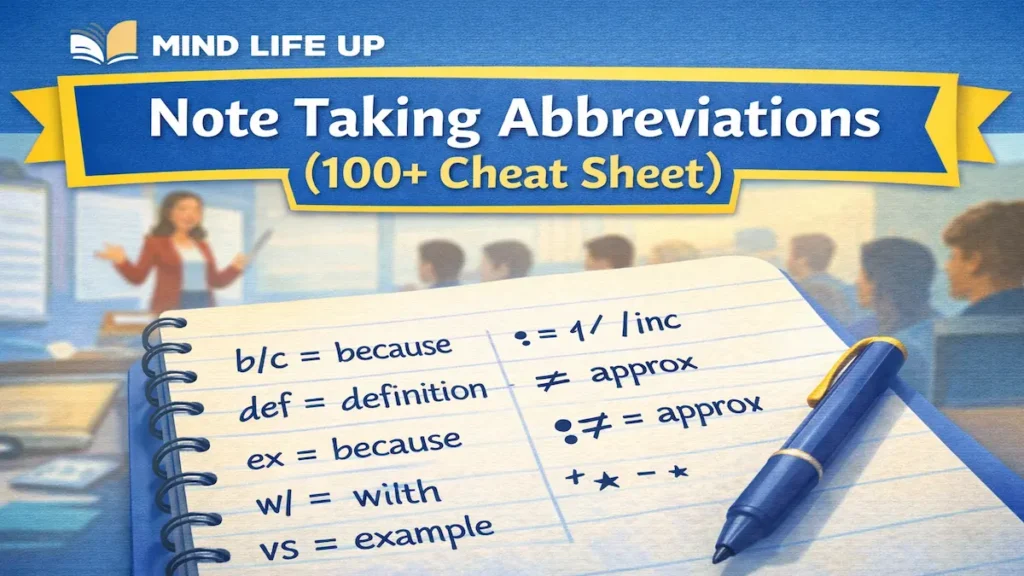
If lectures move faster than your hand can keep up, handwriting isn’t the problem—your shorthand is.
- Quick Start: If you only have 10 minutes, do this…
- Why note-taking shorthand works in college (and when it doesn’t)
- Note taking abbreviations (cheat sheet by category)
- The FAST Notes Method (make your own note-taking shorthand system)
- Real examples (how it looks in actual notes)
- Behind, cramming, overwhelmed: a plan for today + next 48 hours
- Mini-quiz: Is your shorthand system working? (score it)
- Common student mistakes (and fixes)
- Templates & scripts
- Method comparison (optional)
- Key takeaways
- FAQ
- Conclusion
Use these note taking abbreviations and symbols right away, then follow a simple method to build a personal shorthand that’s fast, consistent, and easy to reread later.
Definition (snippet-ready): Note-taking abbreviations are short forms (words, letter combos, and symbols) that replace common phrases in class so you can capture key ideas quickly without missing the next point.
This is for U.S. college students taking lecture-heavy classes (psych, history, econ) and lab-heavy courses (bio, chem), especially during midterms week when time and energy are tight.
Quick Start: If you only have 10 minutes, do this…
- Choose 10 shortcuts from the cheat sheet that match your classes (cause/effect, definition, example, comparison).
- Add 5 symbols (→, ↑, ↓, ≈, ∴).
- Write a one-line shorthand key at the top of your notes page.
- During lecture, only use the shortcuts you chose—don’t invent new ones mid-sentence.
- After class, spend 3 minutes translating messy lines while the lecture is fresh.
Why note-taking shorthand works in college (and when it doesn’t)
Lecture note-taking is a speed-and-filtering job: you’re listening, selecting what matters, and recording it before it disappears. A consistent set of lecture note abbreviations frees up mental space for understanding.
Next step: In your next lecture, use abbreviations only for repeated phrases (not every word). If your notes become confusing, scale back.
When shorthand doesn’t help
- When you abbreviate rare, one-time terms (you’ll forget what they meant)
- When you create five different shortcuts for the same idea
- When your system is so “clever” that you can’t read it during exam revision
Note taking abbreviations (cheat sheet by category)
Use this like a menu: pick what fits your course. The goal isn’t to use all of these—it’s to build a consistent “core set” of abbreviations for notes plus a few high-ROI symbols.
Class workflow words (common lecture phrases)
- abt = about
- app = application
- b/c = because
- b/t = between
- c/o = cause of
- def = definition
- diff = difference
- e.g. = for example
- esp = especially
- ex = example
- info = information
- intro = introduction
- key = important
- lit = literature
- misc = miscellaneous
- neg = negative
- pos = positive
- prob = problem (only if you’re NOT using it for probability)
- prof = professor
- q = question
- req = requirement
- resp = response
- s/t = such that
- w/ = with
- w/o = without
Next step: Circle 8–12 of these that appear frequently on your lecture slides.
Thinking/argument words (helpful for humanities & social sciences)
- arg = argument
- assump = assumption
- concl = conclusion
- crit = critique/critical
- evid = evidence
- imp = important OR implication (choose one meaning)
- lim = limitation
- obj = objective
- opp = opposing
- perspec = perspective
- signif = significant
- supp = support
- theo = theory
- vs = versus
Next step: Pick 5 that match how your instructors talk (e.g., “evidence,” “limitation,” “implication”).
Cause/effect & comparison (great for exams)
- c → e = cause leads to effect
- ∴ = therefore
- b/c = because
- leads to = →
- results in = ⇒
- inc = increase
- dec = decrease
- vs = compared to
- similar = ~
- approx = ≈
- contrast = ↔ (or just “vs”)
Next step: Use arrows to capture relationships instead of writing full cause/effect sentences. Your hand will thank you.
Numbers/time/units (fast + clean)
- = equals
- ≠ not equal
- < less than
- greater than
- % percent
number
- Δ change in
- avg = average
- max/min
- est = estimate
- ~ about/around
- hr = hour
- wk = week
- mo = month
- yr = year
- temp = temperature
- vol = volume
- conc = concentration
Next step: Put a tiny unit key in the margin if your course uses lots of measures (chem, physics, exercise science).
Science & lab (bio/chem/engineering-friendly)
- rxn = reaction
- soln = solution
- aq = aqueous
- ppt = precipitate
- obs = observation
- calc = calculation
- eqn = equation
- var = variable (or variance—pick one meaning)
- ctrl = control
- exp = experiment
- proc = procedure
- mech = mechanism
- incub = incubation
- contam = contamination
- steril = sterilize/sterile (choose one)
- yld = yield
- samp = sample
Next step: Abbreviate repeated steps in lab notes, but write full safety notes and graded requirements.
Math/stats shortcuts (for econ, psych, data courses)
- stats = statistics
- dist = distribution
- corr = correlation
- reg = regression
- var = variance OR variable (pick one)
- sd = standard deviation
- se = standard error
- signif = significant
- ≈ = approximately
- ∑ = sum
- ∝ = proportional to
- Δ = change
- p-val = p-value (use “p” only if you mean probability)
Next step: If your class uses p-values, label them clearly (p-val) so you don’t confuse them with probability later.
Writing & citations (for research papers + reading notes)
- biblio = bibliography
- ch = chapter
- fig = figure
- para = paragraph
- ppl = people
- govt = government
- pol = political
- w/in = within
- ref = reference
- src = source
- “ ” + page # = quote
- ? = unclear / check later
- ! = exam-worthy / big claim
Next step: In reading notes, mark “?” to bring to office hours instead of rereading the entire chapter.
Note-taking symbols you’ll actually use (high ROI)
Memorize these first:
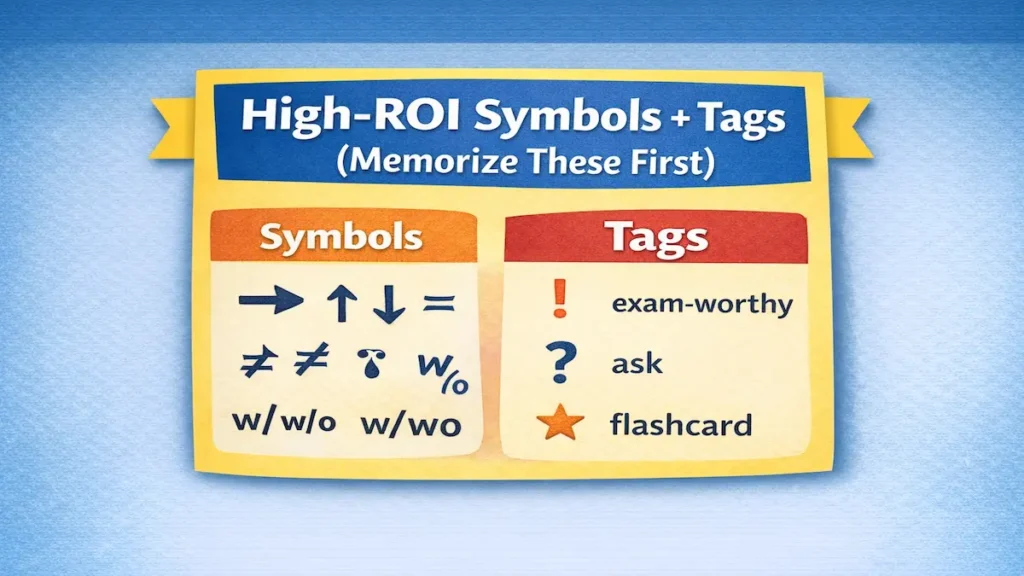
- → = leads to / causes
- ↑ / ↓ = increase/decrease
- ≈ = approximately
- ≠ = not equal
- ∴ = therefore
- w/ / w/o = with / without
Next step: Write these at the top of your page until they become automatic.
Extra shortcuts (mix-and-match to reach 100+)
- gov = government
- env = environment
- edu = education
- beh = behavior
- dev = development
- comm = communication
- org = organization
- indiv = individual
- pop = population
- sys = system
- struct = structure
- func = function
- bio = biology
- chem = chemistry
- phys = physics
- psych = psychology
- soc = sociology
- econ = economics
- hist = history
- lang = language
- vocab = vocabulary
- exam = exam
- hw = homework
- mtg = meeting
- dept = department
- assoc = association
- intl = international
- natl = national
- est = estimate
- approx = ≈ (yes, it’s that useful)
Next step: Don’t adopt all of these. Choose what you’ll see at least twice per class.
The FAST Notes Method (make your own note-taking shorthand system)
A cheat sheet is helpful—but the best shorthand system is one you can use under pressure.
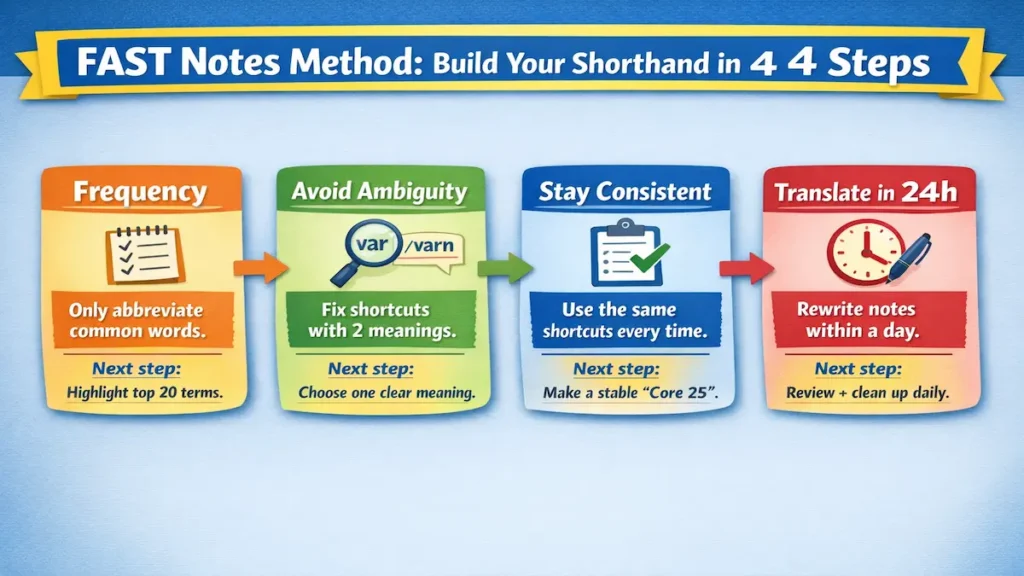
Step 1: Frequency first
Only abbreviate words you write constantly (definition, example, because, increase). High-frequency terms give you the biggest speed boost.
Next step: After one lecture, highlight the 20 words you wrote most often. Those become candidates.
Step 2: Avoid ambiguity
If an abbreviation could mean two things, fix it now. “prob” can be problem or probability. “var” can be variable or variance.
Next step: Choose one meaning, or label clearly (e.g., “prob” = problem, “p(prob)” = probability, “var” = variable, “varn” = variance).
Step 3: Stay consistent
Consistency beats creativity. If you abbreviate “important” as “imp,” don’t switch halfway through the semester.
Next step: Make a “core 25” list and keep it stable for two weeks before changing anything.
Step 4: Translate within 24 hours
Even strong students forget what a rushed squiggle meant. A quick clean-up session locks it in and turns messy notes into usable reviews.
Next step: Set aside a 5–10-minute block after class to rewrite the messiest lines and add headings.
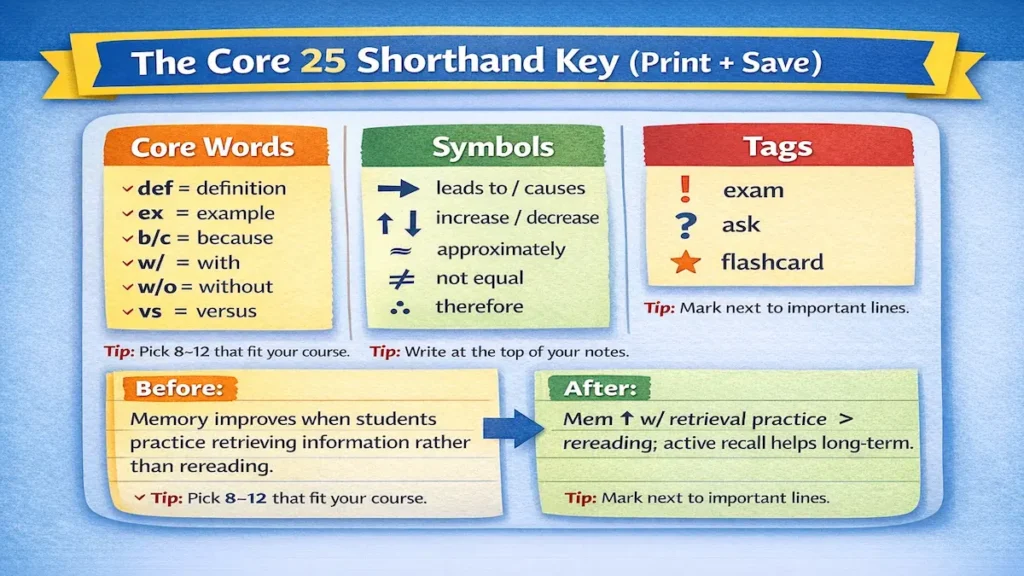
Example Box: The Core 25 Starter Set
def, ex, e.g., b/c, w/, w/o, vs, →, ↑, ↓, ≈, ∴, ≠, imp, evid, concl, arg, theo, signif, lim, proc, obs, calc, eqn, ctrl (+ var with one meaning)
Real examples (how it looks in actual notes)
Example 1: Psychology lecture (fast + readable)
Instead of:
“Memory improves when students practice retrieving information rather than rereading.”
Write:
“Mem ↑ w/ retrieval practice > rereading; active recall helps long-term.”
Next step: Underline “retrieval practice” once, and abbreviate the rest.
Example 2: Biology lab notebook (procedure + observation)
Instead of:
“After incubation, the solution turned cloudy, which suggests contamination.”
Write:
“After incub: soln cloudy → possible contam; obs logged; steril steps reviewed.”
Next step: Keep full details for safety or graded requirements, but shorten repeated steps.
Example 3: Midterms week + commute + part-time shift
Use a quick margin tag system:
- ! = likely exam question
- ? = ask in office hours
- * = add to flashcards
Next step: Mark “!” in the moment—don’t wait until you forget what mattered.
Behind, cramming, overwhelmed: a plan for today + next 48 hours
If you’re already behind, abbreviations help only if they lead to a usable review.
Today (30–45 minutes)
- Skim your last two sets of lecture slides and create a core 15 shortcut list.
- Revisit your most recent notes and add headings + “!” markers.
- Do 10 minutes of retrieval practice: close notes and write what you remember, then check gaps.
Next 48 hours (2 short blocks)
- Block 1: Turn “!” lines into a one-page exam sheet (definitions, comparisons, processes).
- Block 2: Make 10–20 flashcards from your messiest sections (especially definitions + cause/effect).
Next step: Don’t rewrite everything. Triage what you’ll actually be tested on.
Mini-quiz: Is your shorthand system working? (score it)
Answer yes/no and total your “yes” count.
- I can reread my notes 3 days later without having to guess.
- I use the same shortcut for the same idea every time.
- My abbreviations don’t hide key terms (I keep important vocabulary readable).
- I translate unclear lines within 24 hours.
- I mark exam-worthy points during the lecture.
- My system is short enough to remember (core 15–30).
Scoring:
- 5–6 yes: solid system—keep it stable.
- 3–4 yes: refine ambiguity + consistency.
- 0–2 yes: reset with a smaller core list and prioritize readability.
Next step: If you scored 0–2, remove half your shortcuts and rebuild with frequency-first.
Common student mistakes (and fixes)
- Inventing new shortcuts mid-lecture → Pick your core list before class.
- Over-abbreviating key vocabulary → Keep major terms readable; abbreviate glue words.
- Using ambiguous shorthand (“prob,” “var”) → Choose one meaning or label clearly.
- No post-class cleanup → Set a 5-minute translation habit right after lecture.
- Different systems for each notebook → Use one base system, then add a few course-specific terms.
Templates & scripts
Template: Your Personal Shorthand Key (copy/paste)
Core words: def, ex, b/c, w/, w/o, vs, imp, evid, concl, theo
Symbols: →, ↑, ↓, ≈, ∴, ≠
Tags:! exam,? ask, * flashcard
Next step: Keep this at the top of your notes until it’s automatic.
Template: 5-Minute After-Class Cleanup Checklist
- Add 2–4 headings (topics)
- Circle any new terms (write the full word once)
- Translate messy lines
- Add “!” to exam-style claims
- Write 1–2 questions for office hours
Script: What to ask in office hours (fast + specific)
“On [date], my notes say ‘X → Y,’ but I’m unclear on the mechanism. Can you explain the step between X and Y?”
Method comparison (optional)
Method — Best for — Risk — Quick tip
- Abbreviations only — Fast writing — Ambiguity — Keep a core list
- Symbols + arrows — Cause/effect classes — Overuse — Use only for relationships
- Cornell-style notes + shorthand — Exam revision — Takes setup time — Add headings after class
- Typed notes with shorthand — Dense lectures — Temptation to transcribe — Summarize, don’t copy
Key takeaways
- Build a small “core 15–30” shorthand list you can remember under stress.
- Abbreviate frequent phrases, not rare vocabulary.
- Symbols (→, ↑, ↓, ∴) capture relationships faster than sentences.
- Consistency beats creativity—one meaning per shortcut.
- Do a 5-minute translation pass within 24 hours.
- Use tags (!, ?, *) to turn notes into a study plan automatically.
FAQ
What are the best abbreviations for college note-taking?
The best ones are the words you write constantly: definition, example, because, increase/decrease, and comparison terms. Start with a core list, then add only what repeats in your slides and lectures.
Should I abbreviate key terms and vocabulary?
Usually no. Write important concepts in full the first time, then shorten repeated glue words. Your future self needs clarity for exam revision.
How do I keep abbreviations from getting confusing?
Avoid shortcuts with multiple meanings and keep a personal shorthand key at the front of your notebook. Also, translate unclear lines right after class while the context is fresh.
Is typing or handwriting better when using lecture note shorthand?
Either works. Handwriting encourages summarizing; typing can be faster, but it tempts you to transcribe. The win comes from processing the idea, not the tool.
How many note taking abbreviations should I use?
Most students do well with 15–30 core shortcuts and 5–10 symbols. Too many creates mental overhead and makes notes harder to reread.
Conclusion
A good shorthand system should feel like a relief, not another thing to manage. Start small, stay consistent, and translate your messiest lines within a day. With a stable core list, you’ll capture more of each lecture—and your note taking abbreviations will actually help you study instead of turning your notebook into a puzzle.
ز