Best Budget Graphing Calculators for Students: 5 Value Picks for Math Classes
September 19, 2026 / By
mind life up / 12 minutes of reading
Disclosure: This post contains affiliate links. As an Amazon Associate, we earn from qualifying purchases at no extra cost to you.
Read more
A graphing calculator can get expensive quickly, especially when you need one calculator for Algebra II now, calculus next year, and possibly college math after that. The best budget graphing calculators for students aren’t necessarily the cheapest models—they’re the ones that cover the courses you actually expect to take without making you pay for capabilities you won’t use.
This guide compares five non-CAS options from Casio, Texas Instruments, and NumWorks, with an emphasis on value, graphing capabilities, display and power differences, classroom fit, and long-term usefulness. They’re relevant to U.S. high school and college students taking algebra, precalculus, calculus, statistics, physics, and related courses.
Quick Verdict
Rather than calling one calculator the best for everyone, here’s where each makes the most sense.
Best for a tight budget: Casio fx-9750GIII. It provides graphing and Python programming in a monochrome model and is the first one to investigate when keeping the purchase price down is the priority. The trade-off is giving up a color display.[Check Current Price]
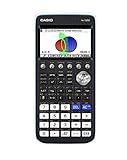
Best budget color option to compare: Casio fx-CG50 PRIZM. Its high-resolution color display and graphing feature set make it worth comparing with the more expensive options in your cart. The trade-off is four-AAA-battery power rather than an integrated rechargeable battery. [Check Current Price]
Best for TI-focused classrooms: TI-84 Plus CE. TI’s familiar 84-series platform, color display, rechargeable battery, and broad course usefulness make it particularly relevant when your teacher or course materials use TI-84 instructions. You’re potentially paying more for that classroom fit than with a budget-first alternative. [Check Current Price]
Best traditional TI option: TI-84 Plus. It keeps the established TI-84 interface and AAA-battery setup without requiring a color screen. Its older monochrome display is the obvious compromise versus the CE. [Check Current Price]
Best for a modern interface: NumWorks Graphing Calculator. NumWorks organizes functionality into apps and includes a color screen, rechargeable battery, and Python. It can be appealing if interface design matters more than matching a traditional TI/Casio workflow. [Check Current Price]
Prices aren’t listed because they fluctuate. For a budget around $70–$130, compare the current checkout prices rather than assuming that the usual price hierarchy will hold on the day you buy.
One important distinction: TI’s current linked product page is for the TI-84 Plus CE Python. Older TI-84 Plus CE units may differ in Python support, so verify the exact model/SKU you’re buying rather than treating every CE as identical.
Casio fx-9750GIII: Best Starting Point for a Tight Budget
Student snapshot: The fx-9750GIII makes the most sense for a student who primarily cares about getting the necessary graphing capabilities without paying extra for a color display.
Why students may like it: Casio positions the fx-9750GIII for coursework including Pre-Algebra, Algebra I and II, Geometry, Trigonometry, AP Calculus, AP Statistics, Biology, Chemistry, Physics, and Business & Finance. That broad course range is important to value: an inexpensive calculator is less useful if you have to replace it when your classes become more advanced.
The calculator uses a monochrome high-resolution LCD rather than the color screen of the fx-CG50. It runs on four AAA batteries. Casio also includes Python programming, giving students a programming option without moving into a premium calculator category.
Key features include graphing, statistics functionality, Python, USB connectivity, and spreadsheet functionality. For a student moving from algebra and precalculus into calculus or statistics, that makes this more than a short-term basic calculator.
Pros:
Broad math and science course coverage
Python programming
AAA batteries are straightforward to replace
Avoids charging extra for a color screen you may not need
Cons:
Monochrome rather than color display
Classroom instructions may require translation if your teacher demonstrates everything on a TI
Battery preference is personal: replaceable AAA cells are convenient for some students, while others prefer recharging
Buy this if: Your first priority is value and you need solid graphing functionality across several math courses.
Skip this if: A color screen or matching your teacher’s TI-84 keystrokes matters more than minimizing cost.
Key trade-off: You get substantial mathematical functionality while accepting a simpler monochrome display.
A value-focused graphing calculator with a monochrome display, Python support, and useful features for algebra, precalculus, calculus, and statistics.
Casio fx-CG50 PRIZM: A Strong Budget Color Option
Student snapshot: The fx-CG50 is for the student who wants a high-resolution color graphing calculator but still wants to compare value carefully rather than automatically buying the default classroom model.
Why students may like it: The major upgrade over Casio’s budget-oriented fx-9750GIII is immediately visible: the fx-CG50 uses a high-resolution color LCD. Casio also provides 3D graphing capabilities, which distinguish it from more basic graphing models.
Casio identifies applications across Algebra I and II, Geometry, Precalculus, AP Calculus, AP Statistics, Biology, Chemistry, Physics, and Business & Finance. Python programming is supported as well.
It uses four AAA batteries instead of the integrated rechargeable system found on the TI-84 Plus CE and NumWorks. That isn’t inherently better or worse for students. Replaceable batteries can be swapped without waiting for a recharge, but you need to keep replacements available.
Pros:
High-resolution color display
3D graphing
Python programming
Useful across a broad range of high school math and science courses
Cons:
Four AAA batteries rather than integrated rechargeable power
Costs more than Casio’s simpler fx-9750GIII when typical price differences apply
A TI-centric class may provide fewer model-specific instructions
Buy this if: You value a color display and expanded visualization features but still want to shop based on value.
Skip this if: You mainly need standard 2D graphs, tables, and calculations. The cheaper fx-9750GIII may cover those priorities without charging you for a nicer display.
Key trade-off: You’re spending beyond the bare-budget tier primarily for a stronger visual experience and additional graphing capabilities.
A color graphing calculator with a high-resolution display, 3D graphing, and Python support for students who want stronger visualization features.
TI-84 Plus CE: Best Fit for TI-Focused Classrooms
Student snapshot: The TI-84 Plus CE is particularly easy to justify when teachers, textbooks, or class handouts give TI-84-specific instructions. That practical compatibility can matter as much as raw specifications.
Why students may like it: Texas Instruments built the TI-84 Plus CE for subjects spanning middle-grade math through algebra, geometry, trigonometry, calculus, statistics, biology, chemistry, and physics.
The current TI-84 Plus CE Python model combines a backlit color display with a rechargeable battery. It can graph functions and work with data, matrices, statistics, and other common high-school and college math operations. The Python edition also includes Python programming alongside TI-Basic.
The CE’s value proposition is different from the less expensive Casio option. You aren’t simply buying graphing capability—you may also be buying easier alignment with a class already built around the TI-84 family.
Pros:
Backlit color display
Rechargeable battery
Python on the current TI-84 Plus CE Python model
Suitable across numerous math and science courses
Particularly practical when instruction explicitly uses TI-84 calculators
Cons:
A cheaper calculator may cover the core math you need
Paying more for classroom familiarity isn’t worthwhile if your class is calculator-agnostic
Python support depends on the exact CE version, so check what you’re purchasing
Buy this if: Your course materials or teacher regularly demonstrate calculations using a TI-84, and you want a color rechargeable model.
Skip this if: Your main criterion is getting core graphing capabilities for the lowest reasonable cost.
Key trade-off: Its value is strongest when you will actually benefit from the TI-84 ecosystem and classroom familiarity.
A rechargeable color graphing calculator well suited to students whose teachers and course materials use the familiar TI-84 platform.
TI-84 Plus: Best Traditional TI Option to Price-Check
Student snapshot: Consider the older TI-84 Plus if you specifically want the conventional TI-84 experience and find it at a price that makes sense compared with the CE.
Why students may like it: The TI-84 Plus remains a capable graphing calculator rather than becoming academically obsolete simply because the CE has a better display. Texas Instruments lists functionality for graphing, calculus, statistics, matrices, financial calculations, and other common operations.
The big differences are physical and technological. The TI-84 Plus has a monochrome display instead of the CE’s backlit color screen and uses four AAA batteries plus a backup battery rather than an integrated rechargeable system.
It supports TI-Basic programming, but students specifically interested in Python should look elsewhere among these five models.
Its budget case therefore depends heavily on current pricing. Don’t assume “older” automatically means “cheaper.” Compare its live price against both the TI-84 Plus CE and Casio fx-9750GIII before purchasing.
Pros:
Established TI-84 workflow
Broad math functionality
Replaceable AAA batteries
Useful for calculus and statistics as well as algebra
Cons:
Monochrome display
No Python programming
Older hardware compared with the CE
Value depends heavily on the actual current price
Buy this if: You want a traditional TI-84 and its current price gives you a meaningful reason to choose it over the CE.
Skip this if: The TI-84 Plus CE is close in price. In that situation, the CE’s color display and rechargeable battery deserve serious consideration.
Key trade-off: You retain the familiar TI-84 platform while giving up the CE’s newer display, rechargeable power, and current Python option.
A monochrome graphing calculator with the familiar TI-84 workflow, broad math functionality, and replaceable AAA batteries.
NumWorks Graphing Calculator: Best for Students Who Want a Modern Interface
Student snapshot: NumWorks is the alternative for students who want calculator software that feels less like a traditional graphing calculator interface.
Why students may like it: NumWorks organizes functions into applications rather than relying on exactly the same workflow as TI and Casio models. Its apps cover calculations, functions, statistics, probability, equations, sequences, regression, and Python, among other uses.
It has a color display and rechargeable battery. Python is integrated into the calculator, making it especially relevant to students who expect to experiment with programming alongside their math coursework.
The interface can be a meaningful differentiator, but classroom context matters. If a teacher says, “press Y=, then GRAPH” while demonstrating on a TI-84, a NumWorks owner has to know the equivalent workflow on their own machine. Students comfortable navigating independently may consider that a minor issue; students who want to follow teacher keystrokes exactly should factor it into their decision.
Pros:
Color display
Rechargeable battery
Integrated Python
App-based interface
Math applications covering functions, statistics, probability, equations, and more
Cons:
Doesn’t mirror TI-84 keystrokes
Less attractive if your class explicitly standardizes instruction around another calculator
Whether it qualifies as “budget” depends on its current price relative to the alternatives
Buy this if: You value a modern interface, color display, rechargeable battery, and Python more than matching a conventional TI workflow.
Skip this if: Your teacher’s calculator demonstrations are central to how you learn and they’re specifically based on TI or Casio.
Key trade-off: A more modern-feeling workflow comes at the cost of being less directly aligned with traditional classroom calculator instructions.
A color graphing calculator with an app-based interface, rechargeable battery, and integrated Python for students who prefer a modern workflow.
How to Choose the Best Budget Graphing Calculator for Students
Price matters, but value is really purchase price divided by how much useful academic life you’ll get from the calculator. A high school sophomore expecting Algebra II, precalculus, calculus, and statistics should consider all four years rather than saving a small amount on something they’ll outgrow.
For most students, these are the factors worth comparing:
Course requirements: Start with your syllabus or teacher’s calculator guidance. For algebra and precalculus, function graphing and tables are core concerns. Calculus students benefit from graphing and numerical calculus capabilities, while statistics courses make statistical functions and data handling especially relevant.
Classroom fit: Matching the teacher’s calculator can make instructions easier to follow. That’s a legitimate reason to spend more, but it isn’t automatically worth paying for if your instructor supports multiple models.
Color versus monochrome: Color can make multiple graphs and visual information easier to distinguish, but a color screen isn’t necessary for basic graphing. A monochrome fx-9750GIII or TI-84 Plus can make more financial sense if functionality matters more than presentation.
Rechargeable versus AAA power: The TI-84 Plus CE Python and NumWorks provide rechargeable power. The Casio models and TI-84 Plus use replaceable AAA batteries. Think about whether you’d rather remember a charging cable or keep spare batteries.
Programming: Don’t pay specifically for programming unless you’ll use it. Python is available on the two Casios, NumWorks, and the current TI-84 Plus CE Python. The standard TI-84 Plus supports TI-Basic instead.
Long-term use: If you’re buying in high school, think beyond this semester. Calculus, statistics, physics, and first-year college coursework may change which features provide value.
Portability: A calculator will probably travel between home, class, and exams. Size and weight therefore matter, but differences in interface, display, and course fit are generally more important than chasing the smallest possible calculator.
What Budget Students Can Usually Skip
Don’t pay extra for an advanced feature simply because it appears impressive on a specification sheet. For many Algebra II and precalculus students, reliable 2D graphing, tables, equations, and statistical functions will matter more often than specialized visualization features.
The same applies to Python. It’s valuable for students interested in programming and potentially useful in STEM education, but it shouldn’t decide the purchase if your actual classes never use it.
CAS is another distinction to understand. Computer algebra systems can perform symbolic operations that these mainstream non-CAS choices aren’t primarily designed around. CAS calculators are typically a separate, more premium purchasing decision, and some exams apply different calculator rules to them.
A Note on SAT, ACT, and AP Exam Compatibility
Never choose a calculator for standardized testing based solely on a retailer saying it’s “approved.” The testing organization—not the manufacturer, school, or store—sets the rules.
College Board currently maintains separate calculator policies for the SAT and AP exams, while ACT maintains its own calculator policy. Rules can change, and AP calculator requirements also differ by exam.
Before test day, check the exact model against the current official policy for the specific exam you’re taking. Pay particular attention to prohibited CAS functionality and any rules about programs or calculator configuration. Approval or suitability for an AP Calculus exam, for example, should not be treated as blanket approval for SAT, ACT, or every other standardized test.
For the digital SAT, also remember that Bluebook includes an embedded Desmos graphing calculator. An approved handheld can still be used under College Board’s current calculator policy, but that changes the value calculation if the SAT is the only reason you’re considering a purchase.
Which Calculator Gives You the Most for Your Budget?
Don’t start with the brand. Start with your classes and current prices.
If keeping the purchase price as low as practical is the main goal, check the Casio fx-9750GIII first. Its monochrome screen is the obvious compromise, while its graphing and Python capabilities give it longer-term potential beyond introductory algebra. [Check fx-9750GIII Price]
If you want color but are still shopping heavily on value, compare the Casio fx-CG50 against the TI-84 Plus CE at their current prices. Choose based on the features and classroom ecosystem you’ll actually use rather than the logo. [Check fx-CG50 Price]
If your math teacher, tutoring center, or course materials consistently use TI-84 instructions, the TI-84 Plus CE becomes easier to justify. The time saved translating calculator instructions can be worth paying for. [Check TI-84 Plus CE Price]
If you’re considering the traditional TI-84 Plus primarily to save money, compare its live price with the CE before purchasing. Its monochrome screen and AAA power aren’t problems by themselves, but the price difference needs to make those compromises worthwhile. [Check TI-84 Plus Price]
If interface design and Python matter more than matching your teacher’s keystrokes, compare NumWorks with the other color models. Its app-based approach offers a distinctly different experience from buying another traditional graphing calculator. [Check NumWorks Price]